FENECON Industrial XL Operating Instructions
1. About these instructions
These installation and service instructions are an integral part of the electrical energy storage system and must be kept in its immediate vicinity and accessible to personnel at all times. Furthermore, all documents listed in the appendix to these installation and service instructions and the operating instructions of the component manufacturers must be observed (link to Applicable documents).
Personnel must have carefully read and understood these operating instructions before starting any work.
|
NOTE Ensure that the latest version of the installation and service instructions is always used. |
In this manual, the product is described as an electrical energy storage system, storage system or system. These terms refer to the battery energy storage system (BESS) supplied.
1.1. Manufacturer
FENECON GmbH
Gewerbepark 6
94547 Iggensbach
Germany
Phone: |
+49 (0) 9903 6280 0 |
Fax: |
+49 (0) 9903 6280 909 |
E-Mail: |
|
Website: |
1.2. Formal information on installation and service instructions
© FENECON GmbH, 2026
All rights reserved.
Reproduction, even in part, is permitted only with the authorization of FENECON GmbH.
<<<
1.3. Version/revision of the installation and service instructions
| Version/Revision | Änderung der Betriebsanleitung | Datum | Name |
|---|---|---|---|
V0 |
Entwurf Ersterstellung |
27.08.2025 |
FENECON GmbH |
V1 |
Freigabe |
01.09.2025 |
FENECON GmbH |
V1 |
Veröffentlichung auf docs.fenecon.de |
10.2025 |
FENECON PM |
V2 |
Überarbeitung |
11.2025 |
FENECON PM Industrial |
V3 |
Überarbeitung Notes |
03.2026 |
FENECON PM (MA) |
2026.06.01 |
Einführung ISO-Warnhinweise |
06.2026 |
FENECON PM (MRH) |
2026.09.01 |
Update SoC, BMZ, optionale Brandbekämpfungsanlage und FEMS-Versionen |
09.2026 |
FENECON PM (SK) |
2026.10.01 |
Information über Anschluss d. WR-Gestells |
10.2026 |
FENECON PM (SK) |

1.5. Structure of Warning Labels
When followed, warning notices help prevent potential injury and property damage, and the signal word indicates the severity of the hazard.
Warnings are structured according to the SAFE method:
| Signal Word | Meaning |
|---|---|
S |
Signal Word (DANGER, WARNING, CAUTION, or NOTICE) |
A |
(German: Art) — Type and source of the hazard |
F |
(German: Folge(n)) — Consequence |
E |
Escape |

|
DANGER |
|---|---|
1.6. Terms and abbreviations
The following terms and abbreviations are used in the installation and service instructions:
| Term/Abbreviation | Meaning |
|---|---|
AC |
Alternating Current |
ADR |
Accord européen relatif au transport international des marchandises dangereuses par route |
BMA |
Fire alarm system |
BMS |
Battery management system |
FACP |
Fire alarm control panel |
CMB |
Current Measurement Board |
CSC |
Cell Supervisor Circuit |
DC |
Direct Current |
EMS |
Energy Management System |
grid operator |
energy supply company |
FEMS |
FENECON Energy Management System |
commissioning |
commissioning |
MCB |
Circuit breaker |
GCP |
grid connection point (GCP) |
NC |
Normally Closed (NC) — normally closed/ normally closed contact |
NMC |
Nickel-Manganese-Cobalt |
PE |
Protective conductor |
PV |
Photovoltaic |
RCD |
Residual Current Device — Residual current device |
RTE |
Round-Trip-Efficiency — System efficiency |
SoC |
State of Charge — State of Charge |
VDE |
German Association for Electrical, Electronic & Information Technologies e. V. |
Widget |
Component of Online Monitoring |
INV |
Inverter |
1.7. Availability
Keep these operating and installation instructions or relevant parts of them within easy reach in the immediate vicinity of the product.
Pass these operating and installation instructions on to the new operator when handing over the product.
Technical changes, images and information in these installation and service instructions are subject to change without prior notice.
1.8. Serial number
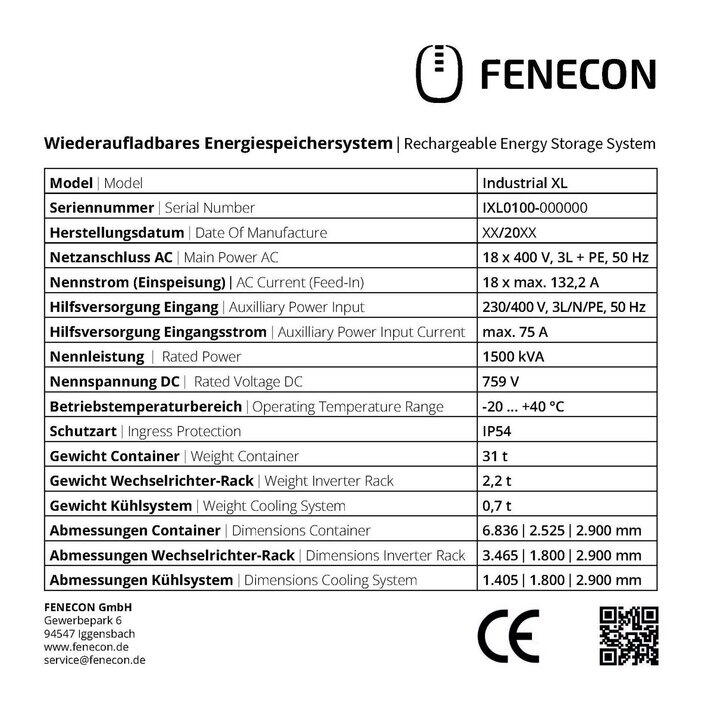
Each electrical energy storage unit is marked with a unique serial number.
This consists of two parts:
-
the product number ("IXL010" for a system with FENECON batteries or "IXL0100" for a storage system with order integration)
-
a consecutive, six-digit numerical code (e. g. 000001)
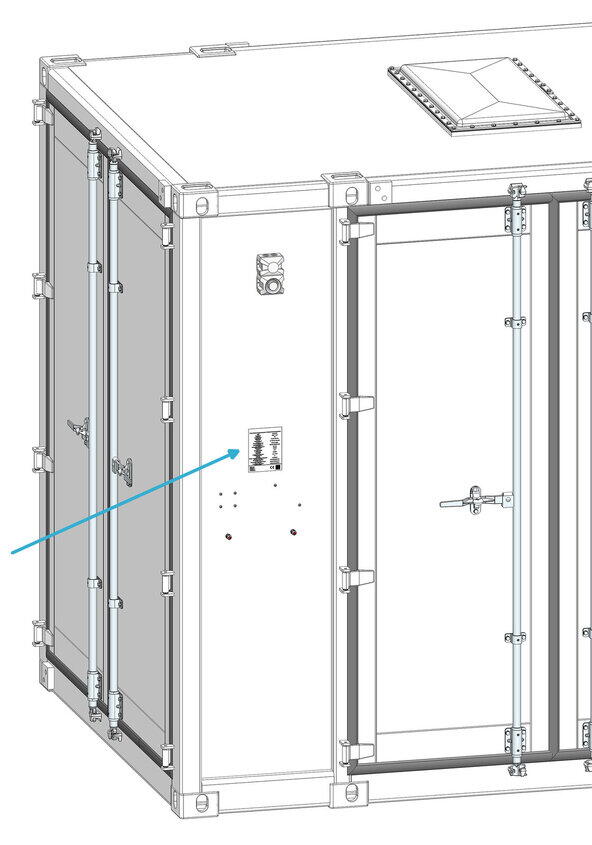
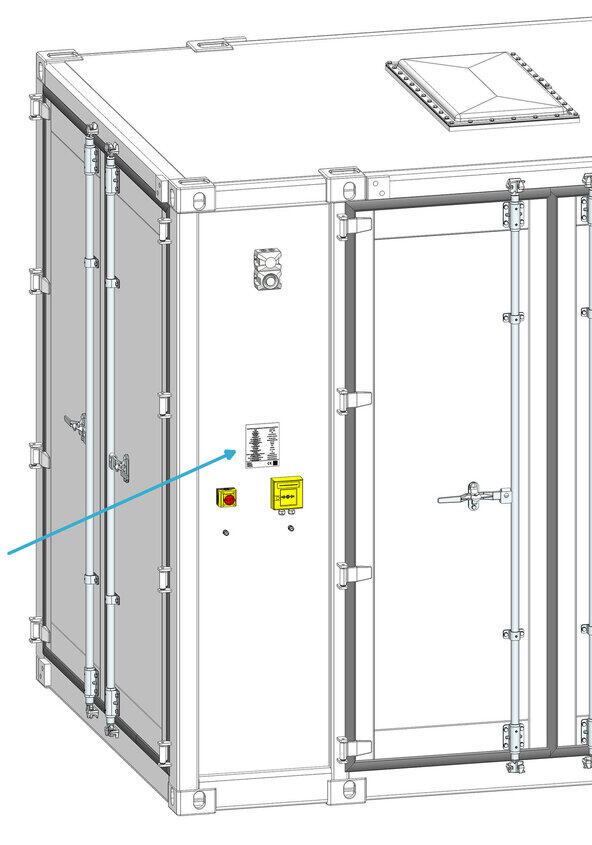
The serial number is located on the type label and is used to uniquely identify the electrical energy storage system. It also provides information on the development status.
Changes in the development status that lead to deviations in operation or maintenance are indicated in these installation and service instructions by specifying the six-digit numerical code.
2. Safety
2.1. Intended use
The FENECON Industrial XL is an industrial energy storage system consisting of various components. These include, in particular, efficient inverters, the FENECON Energy Management System (FEMS) and battery packs (including BMS) as well as a liquid cooling system and room air conditioning. The FENECON Industrial XL large-scale system is offered with an inverter output of 1500 kW and a capacity of 4072 kWh. The energy storage system is used to store and supply electrical energy and is intended for connection to the 400 V/50 Hz low-voltage grid. Any use beyond this purpose is considered improper use.
The electrical energy storage must only be used if no safety-relevant functions are linked to its function.
Use in safety-critical applications, such as for supplying power to medical devices, is not permitted.
2.2. Field of application
The product is intended exclusively for use in the following areas of application:
-
Industrial sector
Any other use is not in accordance with the intended use.
|
The product is designed for use within Europe. For use outside Europe, please contact the FENECON Service. |
2.3. Qualification of staff
To ensure that the system is used, installed and maintained as intended, only qualified personnel must be deployed. The area of responsibility, competence and supervision of the personnel must be precisely regulated by the operator.
The applicable regulations and rules of the German Social Accident Insurance (DGUV) must be observed during all activities on the electrical energy storage system, in particular during installation, operation, maintenance and servicing.
This includes, in particular, the provisions of DGUV Regulation 3 (Electrical systems and equipment) and other relevant DGUV regulations and information. The operator is responsible for ensuring that only instructed and qualified persons carry out work on the system and that the general occupational health and safety guidelines are observed.
Compliance with the DGUV regulations is the responsibility of the operator and is a prerequisite for safe and legally compliant operation of the system.
2.3.1. Trained electricians
Trained electricians means persons who:
-
are able to carry out work on electrical systems due to their technical training, experience and knowledge of the relevant standards and regulations.
-
have been commissioned and trained by the operator to carry out work on electrical systems and equipment of the battery system.
-
are familiar with how the battery system works.
-
recognize hazards and prevent them by taking appropriate protective measures.
-
Have access to all maintenance information.
2.3.2. Service personnel
Work that goes beyond connecting the system must only be carried out by the manufacturer’s specialist personnel. Other personnel are not authorized to carry out this work.
Service personnel include: The manufacturer’s personnel or specialist personnel instructed and authorized by FENECON GmbH, who must be requested by the operator for work on the system (e. g. assembly, repair, maintenance, work on the batteries, etc.).
2.4. Safety and protective devices
The safety devices must not be bypassed or switched off. Operating the system without or with defective protective devices is prohibited. The safety devices must always be freely accessible and must be checked regularly.
The safety devices are permanently integrated into the electrical energy storage system, so that no additional precautions are required during storage.
Maintenance of the safety devices is illustrated as part of the annual maintenance concept and must only be carried out by service personnel or authorized specialists.
All accesses to the electrical energy storage are locked with container doors. Access is only possible with a 4-digit numerical code. Only authorized specialist personnel must open the container.
The electrical energy storage system corresponds to protection class I. The installer of the system is responsible for the proper integration of the system into the local protection concept and for ensuring protection against electric shock in accordance with the applicable national installation standards.
2.4.1. Earthing connections/potential equalization
The electrical energy storage system has three earthing connections on the container and one earthing connection per inverter rack. The system also has two earth circuit connectors on the inverter racks.
The customer’s PE connection in the control cabinet is made via the -X1 supply terminal and can be connected with a maximum cross-section of 50 mm2.
All three PE connections on the customer side (1 x control cabinet, 2 x equipotential bonding rail — inverter rack) must be connected to the same equipotential bonding.
2.4.2. Blitzschutz — Optionspaket
If necessary, the operator is obliged to create a lightning protection concept for the electrical energy storage system and to integrate it into the lightning protection concept. The optional FENECON accessory package for lightning protection can be used for this purpose. If you are interested in option packages, please contact FENECON project at projekt@fenecon.de.
2.4.3. Fire alarm system
The FENECON Industrial XL is equipped with a fire alarm system. This is described in detail in the Fire alarm system section.
In the event of an alarm:
-
Pre-alarm: First point smoke detector has tripped.
-
Contactors of the batteries open.
-
Section switches in the inverters open.
-
Signal to customer interface relay:
-
for electrical energy storage systems with serial number 000001 to 000020: Alarm.
-
for electrical energy storage systems from serial number 000021: Pre-alarm.
-
-
Warning light: Only a visual signaling device on the container triggers (warning light).
-
-
Main alarm: Second point type smoke detector has tripped.
-
Signal to customer interface relay:
-
for electrical energy storage systems from serial number 000021: Main alarm.
-
-
Warning light: Only acoustic signal transmitter on the container triggers (siren).
-

|
NOTICE |
|---|---|
2.4.4. Connection to fire alarm control panel (FACP)
The fire detection system can be connected to an external fire alarm control panel. The connection allows alarm and fault signals to be transmitted to an operator FACP.
- Potential-free contacts are available for connecting to an external alarm panel
-
-
1 x fire alarm system pre-alarm (NO)
-
1 x main alarm (NO)
-
1 x malfunction of the fire alarm system (NC)
-
1 x fire extinguishing system tripped (NC) - optional
-
1 x fire extinguishing system blocked (NC) - optional
-
Max. voltage: 30 V DC
-
Max. switching/continuous current: 3 A
-
-
These are located in the control cabinet on the bottom row of the DIN rails of the Industrial XL:
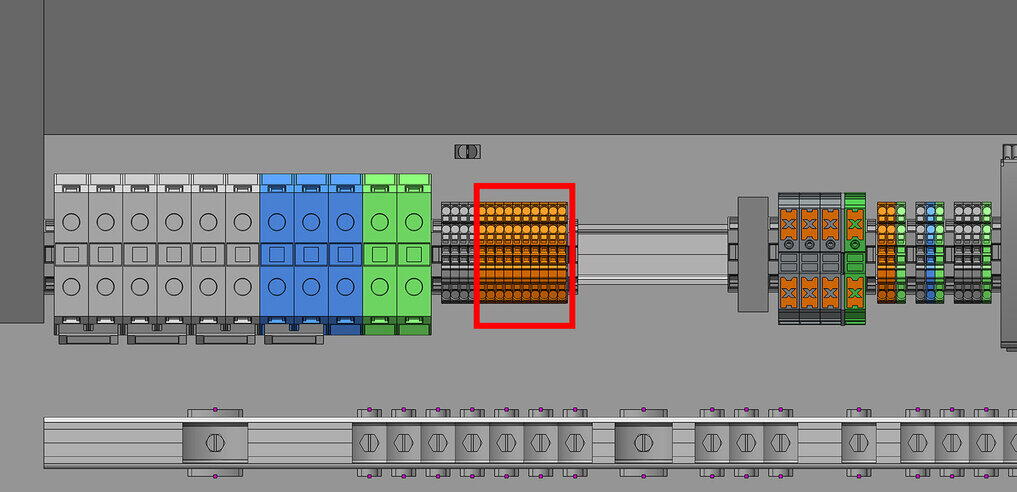
List item |
=CONT+CC-X2 |
|---|---|
1 |
Terminal 5 → Relay for fire alarm system (pre-alarm) |
2 |
Terminal 6 → Relay for fire alarm system (pre-alarm) |
List item |
=CONT+CC-X2 |
1 |
Terminal 7 → Relay for fire alarm system (main alarm) |
2 |
Terminal 8 → Relay for fire alarm system (main alarm) |
List item |
=CONT+CC-X2 |
1 |
Terminal 9 → Relay for fire alarm system (fault) |
2 |
Terminal 10 → Relay for fire alarm system (fault) |
List item |
=CONT+CC-X2 |
1 |
Terminal 11 → Relay for fire extinguishing system (tripped) |
2 |
Terminal 12 → Relay for fire extinguishing system (tripped) |
List item |
=CONT+CC-X2 |
1 |
Terminal 13 → Relay for fire extinguishing system (blocked) |
2 |
Terminal 14 → Relay for fire extinguishing system (blocked) |
Connection cross-section (finely stranded, solid), min. 0.25 mm2 (AWG 22), max. 4 mm2 (AWG 12).
2.5. Residual risks
The product is manufactured in accordance with the current state of the art and recognized safety principles, taking into account the relevant statutory regulations.
Nevertheless, handling the product may pose a risk to people and/or the environment.

|
DANGER |
|---|---|
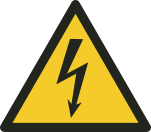
|
DANGER |
|---|---|

|
WARNING |
|---|---|
2.6. Safety instructions
2.6.1. General safety instructions for the electrical energy storage system
-
Select the installation site of the system so that a minimum clearances of 5 m from buildings or comparable structures is maintained.
-
Roofing of the electricity storage system and its components by the customer is not permitted.
-
The system’s protection specification against water is IP54. It is protected against splashing water on all sides, but not against water jets, temporary submersion or flooding (high water).
Installation in areas at risk of flooding is technically possible, but is at the sole responsibility and risk of the operator.
Any warranty and liability claims for damage caused by water ingress as a result of flooding, high water, water jets or standing water are excluded. -
The electrical energy storage system must be installed on a level and load-bearing surface. The Industrial XL installation concept must be observed.
-
The operator must meet the requirements for the floor conditions, which can be found in the Industrial XL installation concept.
-
Read the instructions for installation and operation to avoid damage due to incorrect installation/operation.
-
Only operate the system under the specified environmental conditions.
-
The electrical energy storage system must only be used under the specified charging/discharging conditions (see Technical data).
-
The electrical energy storage system must be operated or maintained by authorized personnel. Children and unauthorized persons are prohibited from accessing the system. Keep animals away from the system, as they can damage cables or other components and thereby pose a hazard. Ensure this is done, particularly in public areas, by installing appropriate fencing.
-
The system operator is required to identify and assess potential tripping hazards in the vicinity of the storage system.
-
The battery packs may have insufficient cell voltage after a long storage period. For more information, see section Storage.
-
The operator is prohibited from charging the battery packs with an external charger.
-
Do not expose the battery packs to high voltage.
-
Do not short-circuit/bridge the batteries.
-
Do not touch the battery plugs (+) and (-) directly with a wire or metal object (e. g. metal chain, hairpin). Excessive current can be generated in the event of a short circuit, which can lead to overheating, explosion or fire of the battery packs.
-
The battery packs must only be removed or replaced by service personnel.
-
Only transport the battery packs as hazardous goods.
-
Observe the applicable laws, regulations and standards when transporting the battery packs.
-
Before transport, ensure that the battery packs fulfill the indicated transport requirements (e.g. defined state of charge, secured connections, protective covers). This is the only way to ensure safe and compliant transportation.
-
Only use the battery packs as intended. Improper use can lead to overheating, explosion or fire of the battery packs.
-
Do not dismantle or modify the battery packs. The battery packs integrate a safety mechanism and a protective device, damage to which can lead to overheating, explosion and/or fire of the battery packs.
-
Protect the area of the electrical equipment and batteries from moisture and water.
-
Prevent water ingress when working on the electrical energy storage system.
-
Do not apply any mechanical force to the battery packs. The battery packs can be damaged and short circuits can occur, which can lead to overheating, explosion or fire of the battery packs. If damage to the battery packs is detected, contact FENECON Service immediately.
-
Do not crush, throw, drop or attempt to open the battery packs. Do not use the dropped battery pack and contact FENECON Service immediately.
-
Do not place any objects on the battery packs.
-
Do not step on the battery packs.
-
Do not use the battery packs if, during assembly, charging, normal operation and/or storage, changes in color, mechanical damage, leakage of liquids or deformation are detected or if evaporating gases can be smelled. If one of the cases mentioned here occurs, contact FENECON Service immediately.
-
If a battery exhibits unusual odours, excessive heating, a change in color or shape, leaking electrolyte solution or other abnormalities, it must be reported to authorized service personnel immediately. Otherwise there is a risk of overheating, explosion or fire. Only authorized service personnel must remove the battery from the battery tower.
-
Eye and skin contact with leaked electrolyte solution must be avoided. After contact with eyes or skin, rinse/clean immediately with water and seek medical attention. Delayed treatment can cause serious damage to health.
-
No work such as soldering, welding, drilling, grinding or other mechanical or thermal processing must be carried out on the battery packs or in their immediate vicinity. Work of this kind entails the risk of flying sparks, the formation of chips or the effects of heat. This can damage the insulator and the safety ventilation mechanism and lead to overheating, explosion or fire of the battery packs
2.6.2. Installation, operation and maintenance
Always observe the following safety instructions when installing, operating or maintaining the battery packs:
-
Installation work on the electrical energy storage system and making the cable connections must only be carried out by authorized and trained electricians.
-
Commissioning and maintenance work on the battery packs or the electrical energy storage system must only be carried out by authorized service personnel.
-
During assembly and maintenance work on the battery tower, service personnel must stand on dry insulating objects and must not wear any metal objects (e. g. watches, rings and necklaces) during maintenance work/operation.
-
Use insulated tools and wear personal protective equipment.
-
The battery packs can cause electric shock and burns due to short-circuit currents.
-
Do not touch two charged contacts with a potential difference.
-
Check that there is no voltage present on the battery pack using a two-pole voltage tester in accordance with DIN VDE 0682-401.
-
If an anomaly is detected, actuate the maintenance switch (if directly accessible).
-
Do not continue the maintenance work until the cause of the fault has been rectified.
2.6.3. Fire protection
-
Do not heat the battery packs. Excessive overheating can cause insulation materials to melt. This can cause the battery packs to explode or catch fire.
-
Do not expose the battery packs to open fire or dispose of them in a fire.
-
Do not set up or use any open sources of fire, heating or high temperatures in the vicinity of the electrical energy storage unit.
-
Keep the battery packs away from sources of heat and fire, flammable, explosive and chemical materials.
-
Avoid contact between the battery packs and conductive objects (e. g. wires).
-
Use the operating fluids and coolants specified by the manufacturer.
-
Maintain the prescribed clearances around the electrical energy storage system in accordance with the installation concept.
-
Fire, open light and smoking in the installation area of the electrical energy storage system is prohibited.
-
The fire alarm system must only be serviced by service personnel.
2.7. Behavior in emergency situations
In an emergency (e. g. smoke, fire, unusual noises or odors), proceed as follows:
-
Disconnect the electrical energy storage system from the grid as far as safely possible.
-
Leave the danger zone immediately.
-
Cordon off the danger zone and prevent access.
-
Alert the relevant emergency services.
-
Warn neighbors and other persons at risk immediately.
-
Do not attempt to extinguish the fire yourself. Extinguishing must only be carried out by the emergency services using suitable means (see fire protection in Applicable documents).
-
Alert a doctor in the event of injuries.
2.8. Reasonably foreseeable misuse
All applications that do not fall within the scope of the intended use are considered misuse.
2.8.1. Safety rules
Work on live parts is generally not permitted. Electrical work must only be carried out by qualified electricians.
The following safety rules must be observed for all work on electrical components:
-
Disconnect.
-
Secure against restarting.
-
Check that there is no voltage.
-
Earth and short-circuit.
-
Cover or shield neighboring and live parts.
Non-compliance with the safety rules is considered a reasonably foreseeable misuse.
2.9. Other misuses
Misuses are:
-
improper transportation, installation, assembly, trial operation or operation that may damage the product,
-
change in the specified technical characteristics, including the individual components,
-
change or deviation of the connected load,
-
functional or structural changes,
-
Operating the product in a faulty or defective condition,
-
improper repairs,
-
use by untrained persons (instruction in accordance with the installation and service instructions is provided by the operator),
-
operation without safety devices or with defective safety devices,
-
disregarding the information in the original operating instructions,
-
unauthorized access via the control unit or the network,
-
Fire, open light and smoking in the vicinity of the storage system,
-
insufficient ventilation,
-
unauthorized changes and actions to the electrical energy storage system,
-
Private use,
-
Use as mobile energy storage,
-
Direct use in a PV system.
-
NOTE: Only AC-side feed-in is possible.
-
2.10. Pictograms
Pictograms on the system indicate dangers, prohibitions and instructions. Illegible or missing pictograms must be replaced by new ones.
| Pictogram | Meaning | Location |
|---|---|---|
|
|
Warning: Dangerous Electrical Voltage |
Pictogram on the housing and labeling of components where it is not immediately apparent that they contain electrical equipment that could pose a risk of electric shock. |

|
Warning: Corrosive Substances |
On the battery packs. |

|
Ground before use |
In the area of the earthing connections (e. g. on the container) |

|
Waste electrical and electronic equipment does not belong in household trash but must be collected and disposed of separately! |
On the battery packs. |

|
Warning: Risk of hand injury |
|
|
|
Warning: Hot Surface |
|
|
|
General warning symbol |
|

|
Warning regarding hazards associated with charging batteries |
On the battery packs. |
| Pictogram | Meaning | Position |
|---|---|---|

|
General prohibition sign |
|

|
Flame/ignition source; fire, open ignition sources, and smoking prohibited |
|

|
No entry for persons with pacemakers or implanted defibrillators |
|
|
|
Unauthorized entry prohibited |
|

|
Read the manual and follow the instructions before assembly and use |
|

|
Wear protective headgear. |
|

|
Wear safety boots or shoes. |
|

|
Wear protective gloves. |
2.11. Operating materials/equipment
2.11.1. Electrolyte solution of the battery packs
|
|
WARNING |
|---|---|
Delayed treatment can cause serious damage to health.
-
Electrolyte solution is used in the battery packs (NMC).
-
The electrolyte solution in the battery packs is a clear liquid and has a characteristic odor of organic solvents.
-
The electrolyte solution may crystallize after discharge.
-
The electrolyte solution in the battery packs is flammable and corrosive.
-
Contact with electrolyte solution can cause severe burns to the skin and damage to the eyes.
-
Do not inhale the vapors.
-
Leave the contaminated area immediately after inhaling the vapors.
-
If the electrolyte solution is swallowed, induce vomiting.
|
NOTE Further information on the electrolyte solution can be found in the safety data sheet for the batteries. |
2.11.2. Agent of the cooling system
|
NOTE The coolant used in the cooling system is R513a. Observe the relevant supplier documentation. |
-
Contains pressurized gas. The container may explode if heated.
-
Rapid evaporation or contact with the liquid can cause frostbite.
-
The vapors are heavier than air and can accumulate in deep areas, reducing the oxygen concentration.
-
If concentrations are too high, anesthetic effects may occur.
-
Misuse or intentional inhalation can be fatal without alarming symptoms due to effects on the heart.
-
Inhalation of the coolant can cause cardiac arrhythmia.
-
Thermal decomposition can produce toxic and corrosive compounds.
2.11.3. Electrical equipment
-
Work on electrical equipment must only be carried out by trained electricians.
-
Maintenance work must only be carried out by trained specialist personnel (service personnel).
-
Before starting work on the electrical energy storage system, visually check for insulation and housing damage.
-
Regularly carry out checks for insulation and container/housing damage.
-
The system must never be operated with faulty or non-operational electrical connections.
-
Only insulated tools must be used for maintenance on uninsulated conductors and terminals.
-
Control cabinets (e. g. inverter housing) must always be kept locked. Only authorized personnel with appropriate training and safety instructions (e. g. service personnel) should be allowed access.
-
The inspection and maintenance intervals for the electrical components specified by the manufacturer must be observed. Details can be found in the maintenance instructions.
-
To avoid damage, lay supply lines without crushing and shearing points.
-
If the main switch is disconnected, specially marked external circuits may still be live!
-
Dangerous residual voltages may still be present on some equipment (e. g. inverters) with an electrical intermediate circuit for a certain period of time after disconnection. Check that there is no voltage on these systems before starting work.
2.12. Notes on occupational health and safety
The obligations arising from occupational health and safety must be implemented by the operator of the low-voltage equipment.
Operator obligations in relation to the use of the product:
-
Make these installation and service instructions or extracts thereof available to persons who carry out tasks with or in connection with the product.
-
Provide the Applicable documents to these persons.
-
Instruction of persons with regard to the intended use as well as the prohibited use.
-
Instruction of persons with regard to safety devices and supplementary protective devices.
-
Instruction of persons with regard to all residual risks.
2.13. Personal protective equipment
Depending on the work on the system, personal protective equipment must be worn:
-
Protective footwear.
-
Protective gloves, cut-resistant if necessary.
-
Protective eyewear.
-
Protective headgear.
-
Safety vest.
-
Fall protection.
Carry a first aid kit with you.
2.14. Spare and wear parts
The use of spare and wear parts from third-party manufacturers can lead to risks. Use only original parts or spare and wear parts approved by the manufacturer. Observe the instructions for spare parts.
|
NOTE Contact the manufacturer for further information. |
2.15. IT security
FENECON systems and their applications communicate and operate without an internet connection. The individual system components (inverters, batteries, etc.) are not directly connected to the internet or accessible from the internet. Sensitive communication via the internet is processed exclusively via certificate-based TLS encryption.
-
Access to the programming levels is not barrier-free and is accessible at different levels depending on the qualifications of the operating personnel. Safety-relevant program changes require additional verification.
-
FENECON processes energy data of European customers exclusively on servers in Germany and these are subject to the data protection regulations applicable in this country.
-
The software used is checked using automated tools and processes established during development in order to keep it up to date and to rectify security-relevant vulnerabilities at short notice. Updates for FEMS are provided free of charge for life.
3. Technical data
3.1. General
Die maximale Leistung von 1.500 kVA basiert auf einer Leistungskennlinie, die mit einer frisch kalibrierten Batterie ermittelt wurde. Unter diesen Bedingungen steht die maximale Leistung im SoC-Bereich von 2-98 % zur Verfügung. Da der angezeigte SoC zwischen Kalibrierungen driftbedingt vom tatsächlichen Ladezustand der Batterien abweichen kann, können sich die für die maximale Leistung verfügbaren SoC-Grenzen entsprechend verschieben. Eine regelmäßige Kalibrierung der Batterien stellt sicher, dass der angezeigte SoC den tatsächlichen Ladezustand möglichst genau abbildet. Hierzu ist das Speichersystem bis zur automatischen Beendigung des Entladevorgangs zu entladen. Die Kalibrierung gilt als abgeschlossen, wenn die maximal verfügbare Entladeleistung 0 kW beträgt.
3.2. System overview
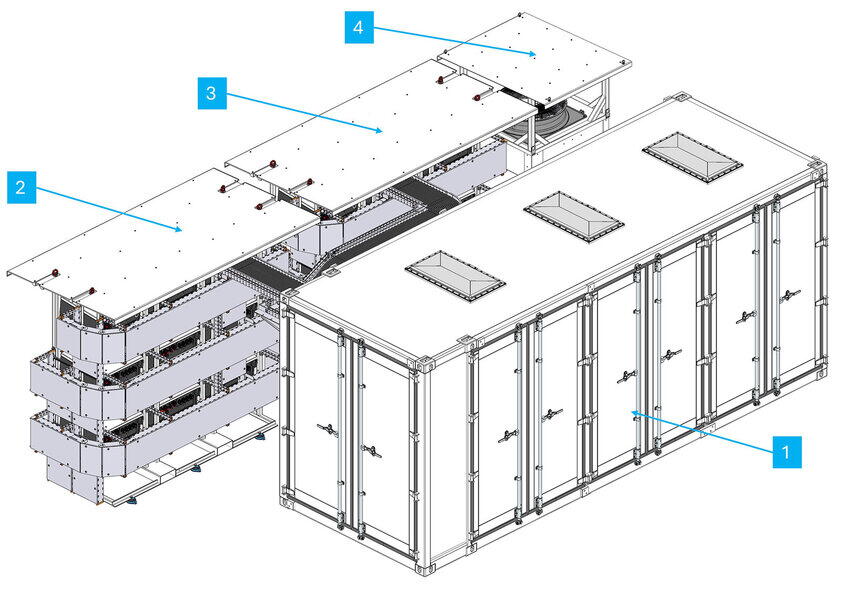
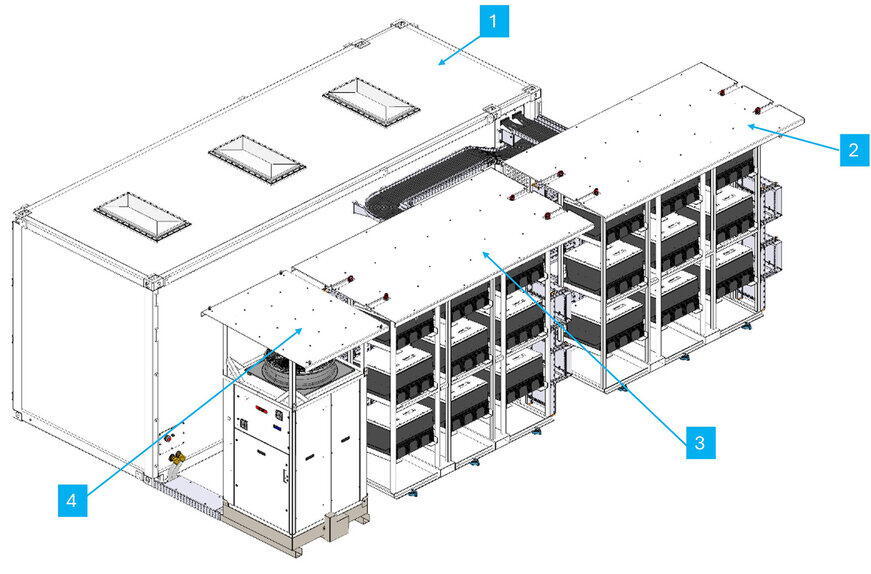
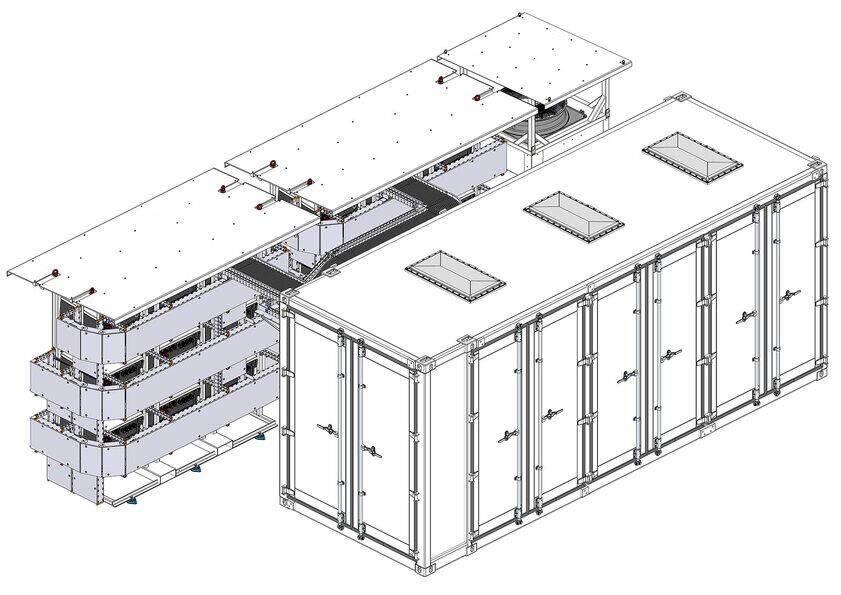
3.3. Battery container
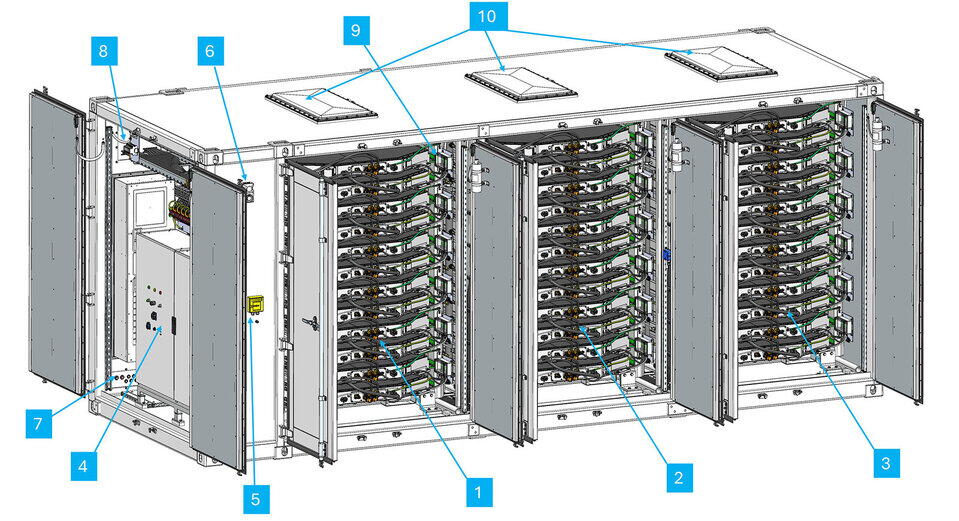
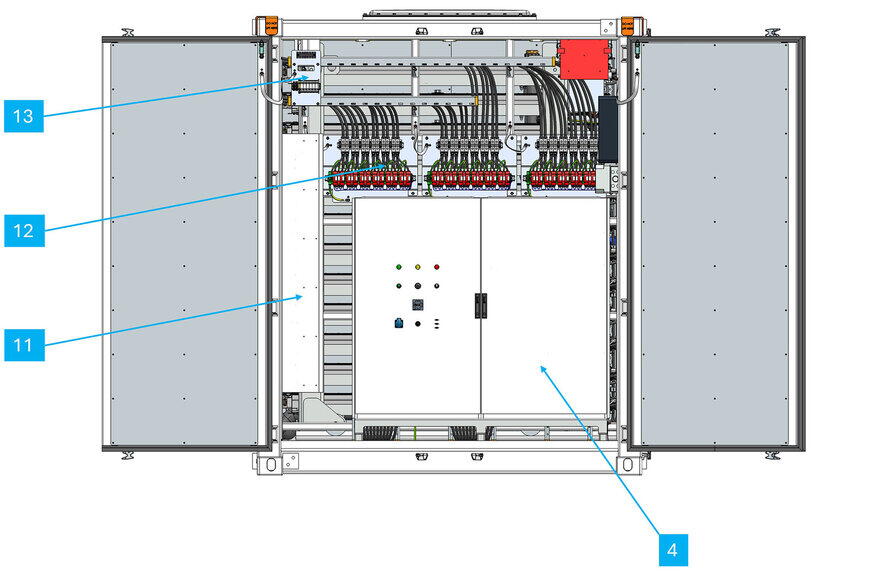
1 |
Battery rack 1 |
8 |
Cable bushing — Inverter |
2 |
Battery rack 2 |
9 |
F2B box |
3 |
Battery rack 3 |
10 |
Explosion vent panels |
4 |
Control cabinet |
11 |
Room air conditioning system |
5 |
Manual activation switch |
12 |
Cable bushings — Inverter |
6 |
Visual and acoustic signaling device |
13 |
Overvoltage protection — Inverter communication |
7 |
Cable bushings — Control cabinet |
3.3.1. Steel construction — Battery containers
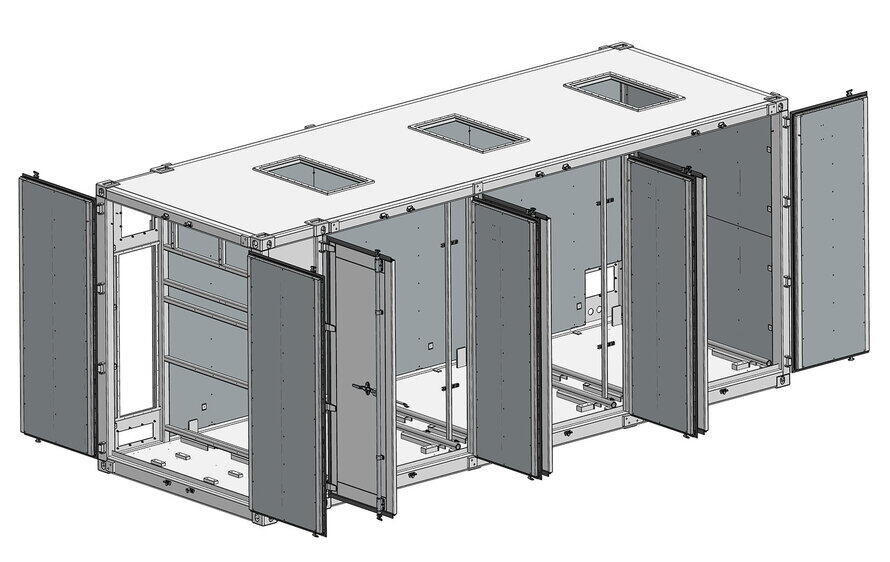
The underlying steel construction of the FENECON Industrial XL has been statically tested and meets all requirements.
The surface coating is RAL9010 pure white in accordance with C4H.
The weight of the steel structure is 6,340 kg.
3.3.2. Control cabinet
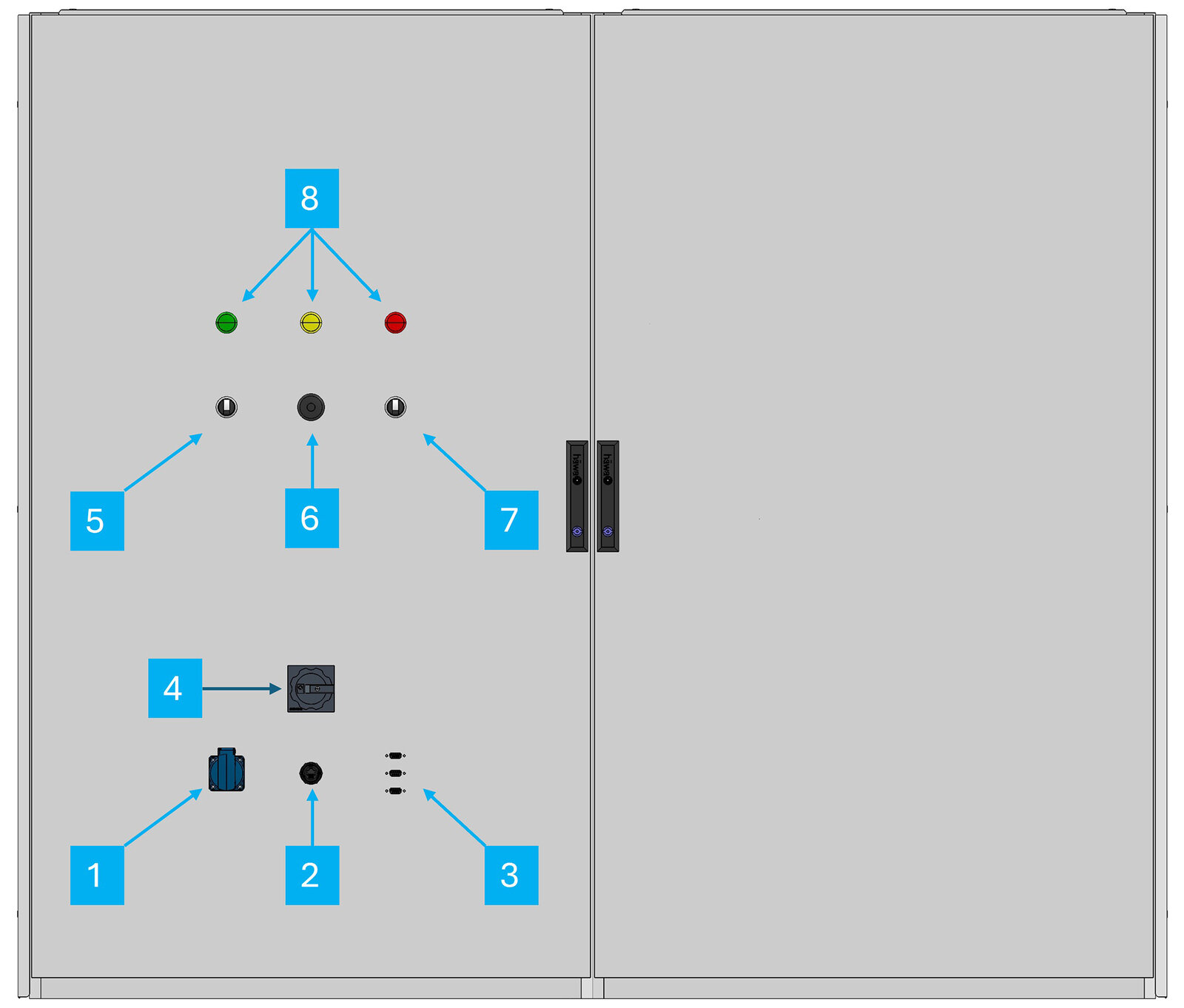
1 |
Service socket |
5 |
Container lighting OFF/ON |
2 |
Service network interface |
6 |
Maintenance switch |
3 |
CAN bus interface Rack 1-3 |
7 |
Buffering 24 V Rack 1-3 OFF/ON |
4 |
Main switch |
8 |
Indicator lights: green (operation), yellow (warning), red (fault) |
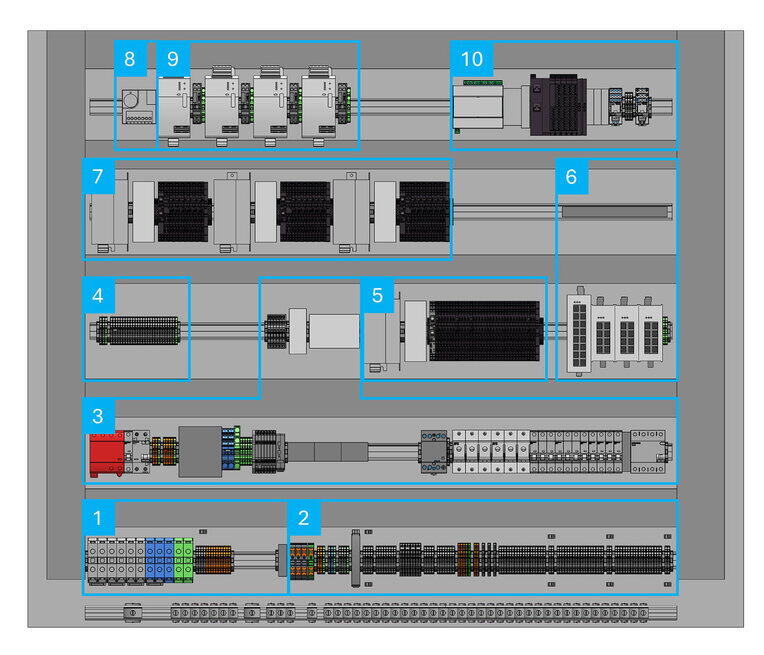
1 |
AC feed-in/interface — Customer |
6 |
Network |
2 |
Interface — Container/air conditioning |
7 |
24 V distribution — F2B |
3 |
AC supply |
8 |
Control cabinet thermostat |
4 |
Interface — Control cabinet door |
9 |
24 V supply — F2B |
5 |
24 V distribution (internal) |
10 |
FEMS/IO system |
3.3.3. AC connection area
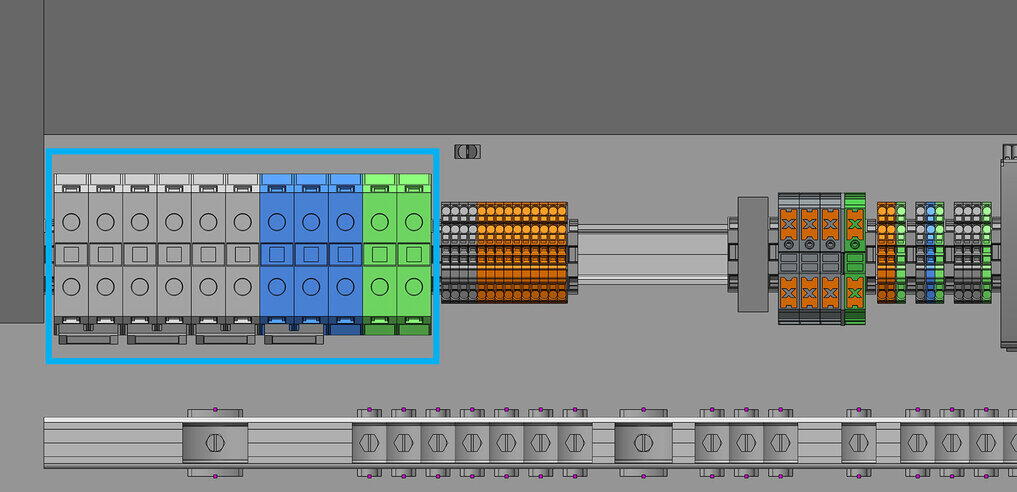
-
AC connection (customer-side)
-
Max. connection cross-section: 50 mm2
-
Pre-fuse: 80 A, operating class: gG
-
Possible network configurations: TN-C / TN-S
|
NOTE
|
3.3.4. DC connection area
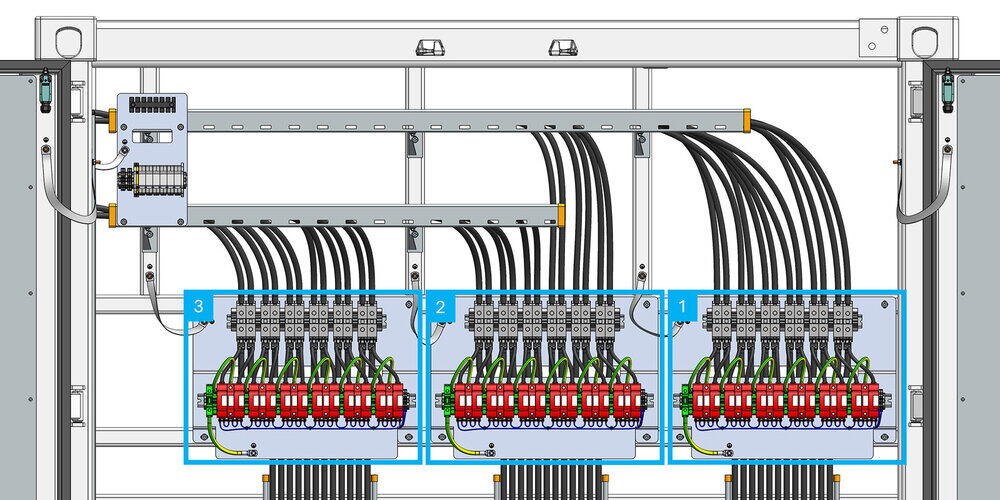
1 |
DC connection plate for battery tower 1 |
3 |
DC connection plate for battery tower 3 |
2 |
DC connection plate for battery tower 2 |
3.3.5. Feedthroughs
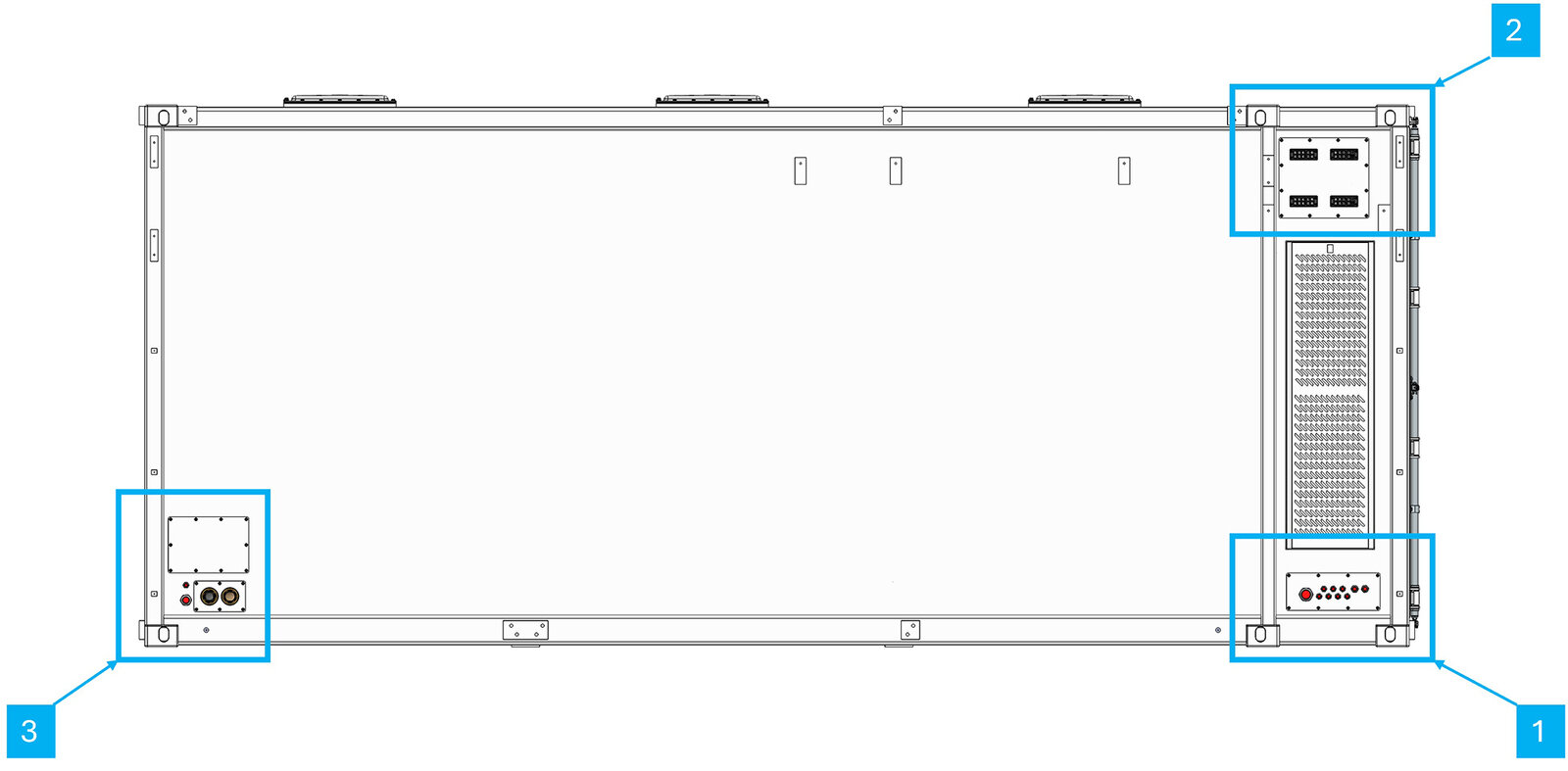
1 |
Feedthroughs — Control cabinet |
3 |
Feedthroughs — Cooling system |
2 |
Feedthroughs — Inverter |
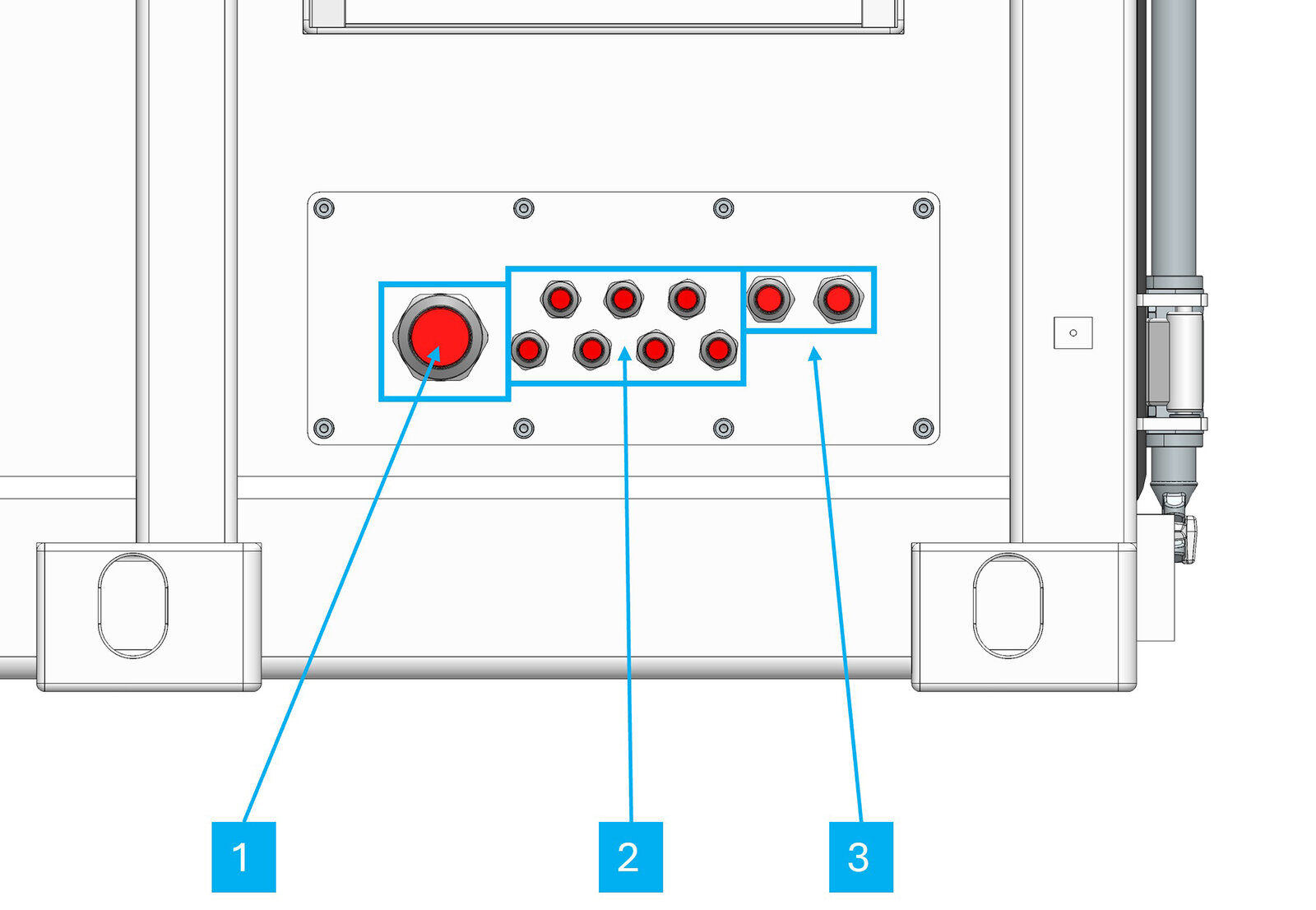
1 |
AC supply — customer, max. 50 mm2 |
3 |
internet — customer |
2 |
Communication connection — Customer
|
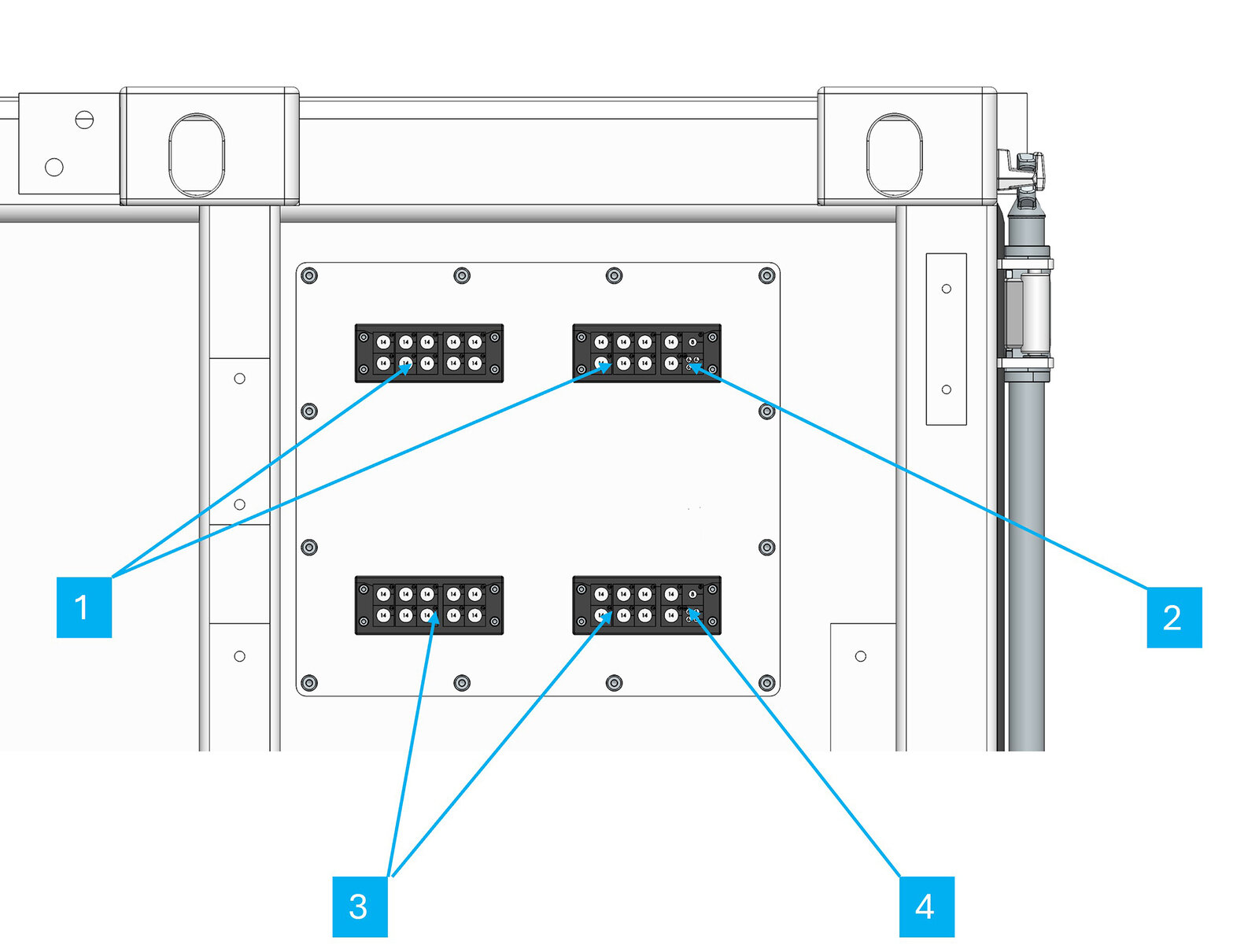
1 |
DC inverter rack 1/front |
3 |
DC inverter rack 2/cooling |
2 |
Communication — Inverter rack 1/front |
4 |
Communication — Inverter rack 2/cooling |
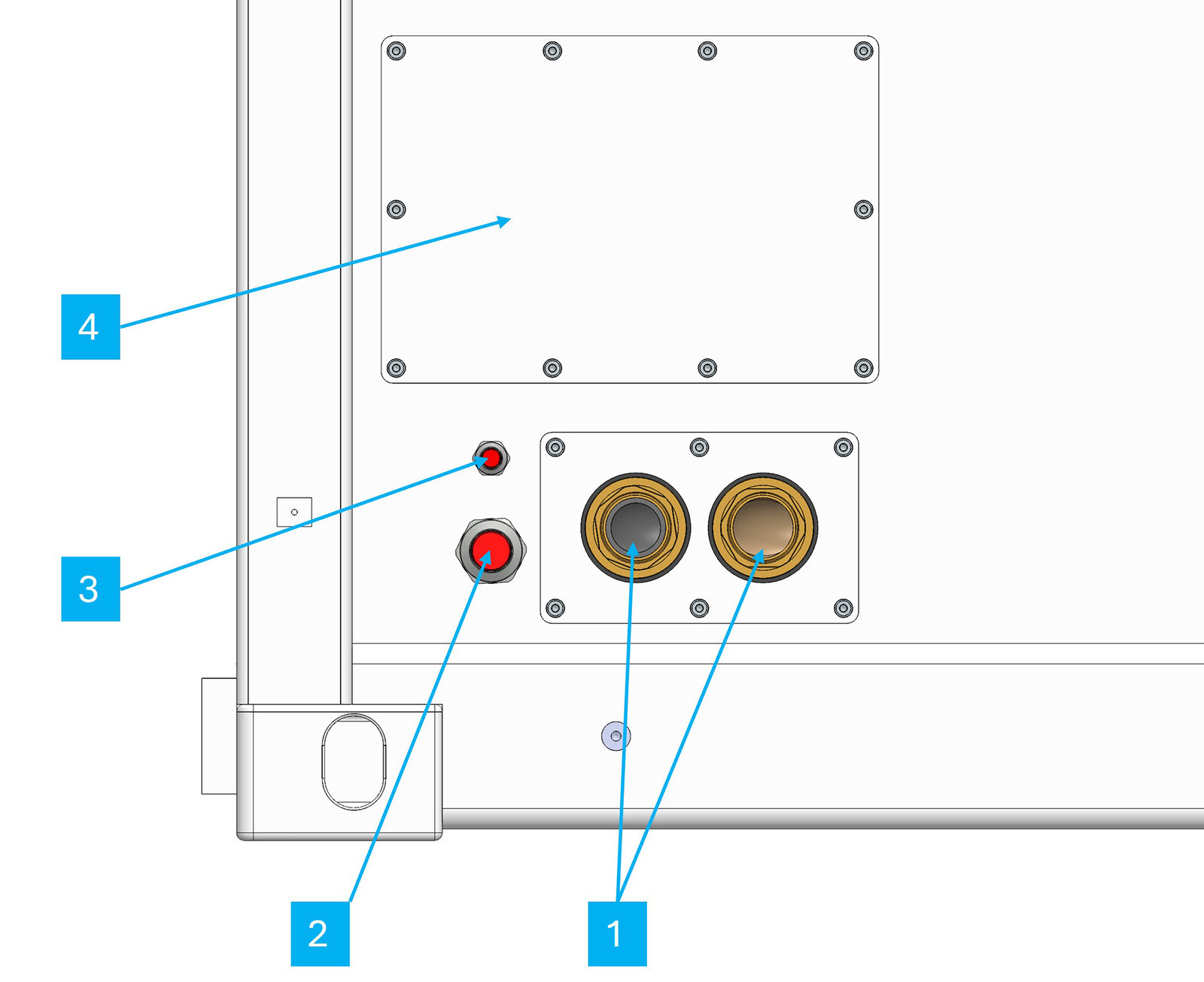
1 |
Cooling system supply and return lines |
3 |
Communication — Cooling system |
2 |
AC supply — Cooling system |
4 |
Maintenance access — Connection area |
3.3.6. Battery tower
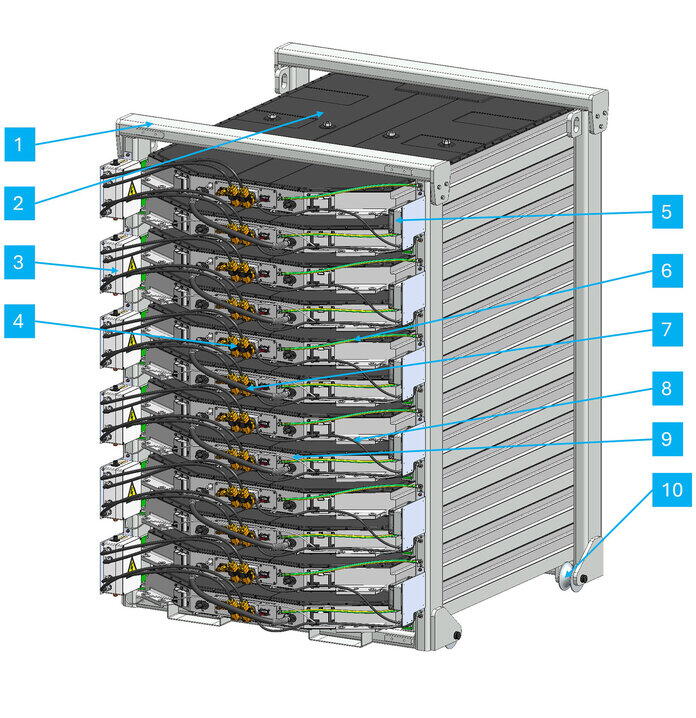
1 |
Steel frame |
6 |
Grounding cable — Battery |
2 |
Battery pack |
7 |
Serial cooling connection between battery strings |
3 |
HV800 box (high-voltage 800 V box) on carrier plate |
8 |
Communication connection battery to F2B |
4 |
Amphenol DC connector on batteries |
9 |
F2B-to-HV800 communication connection |
5 |
F2B box (FEMS-2-Battery box) on carrier plate |
10 |
Rollers of the battery tower |
3.3.7. Battery
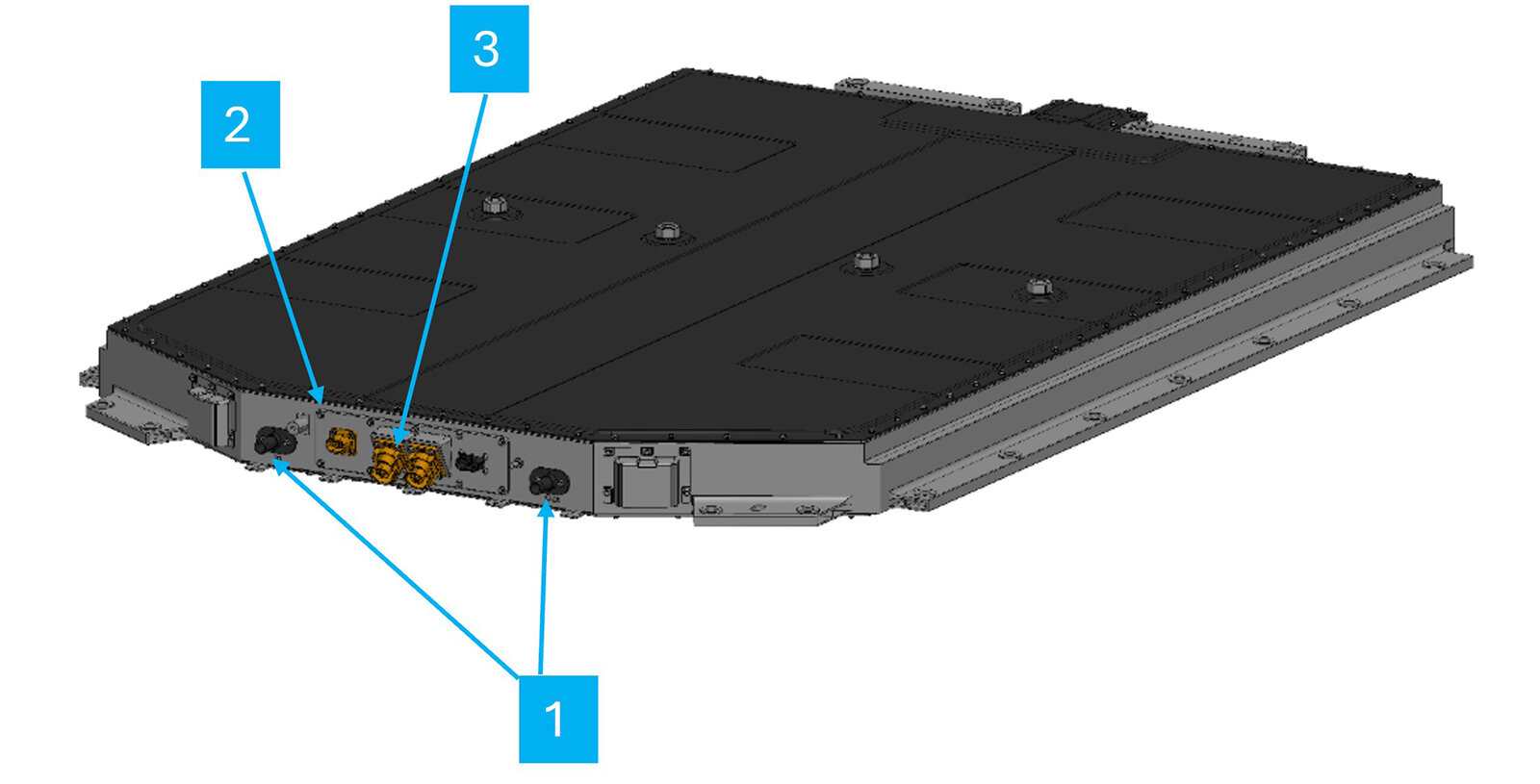
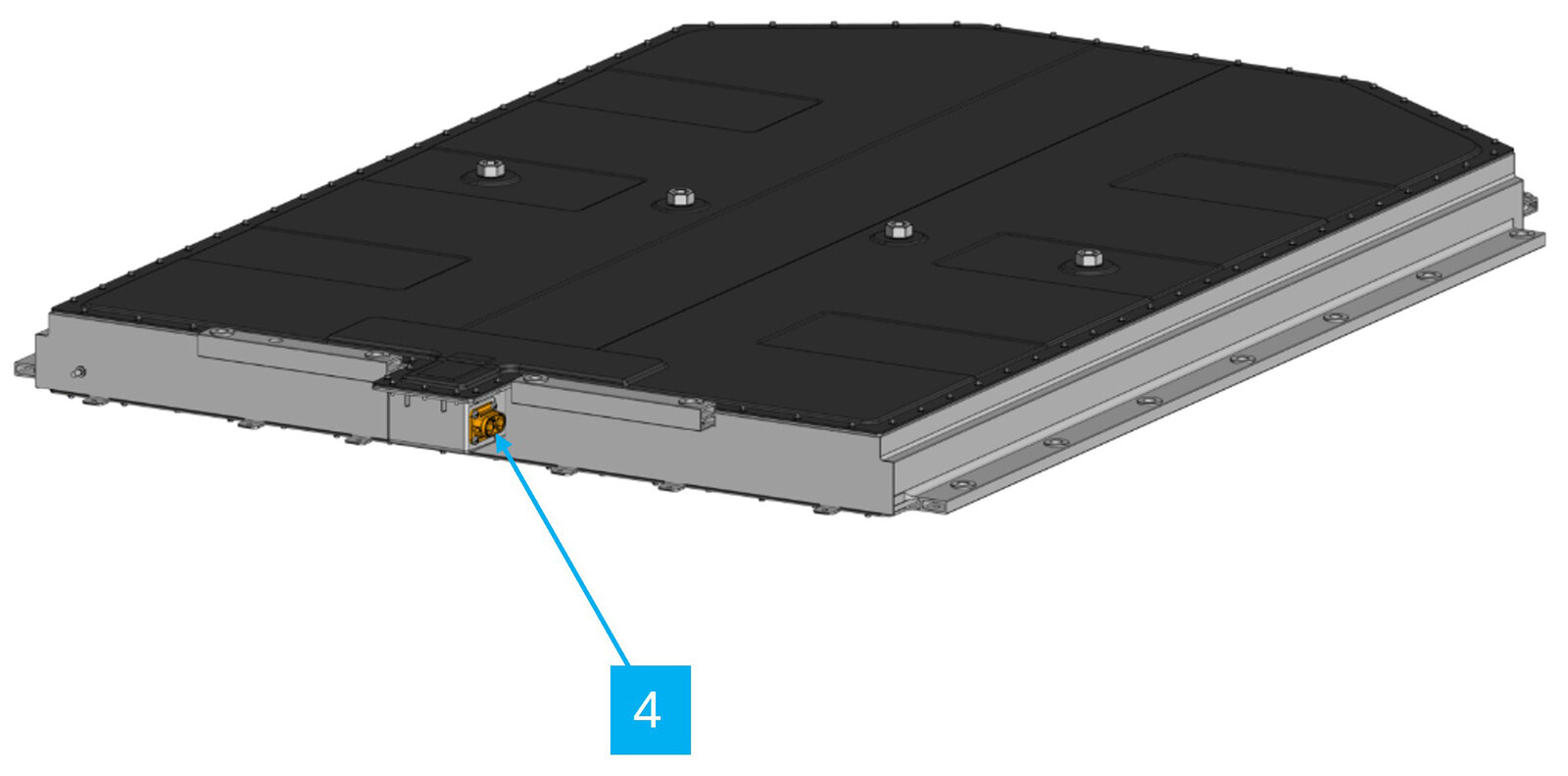
1 |
Cooling water connection supply and return |
3 |
Front HV connections |
2 |
Additional HV connection |
4 |
Additional HV connection (rear) |
3.3.8. Cooling system distribution
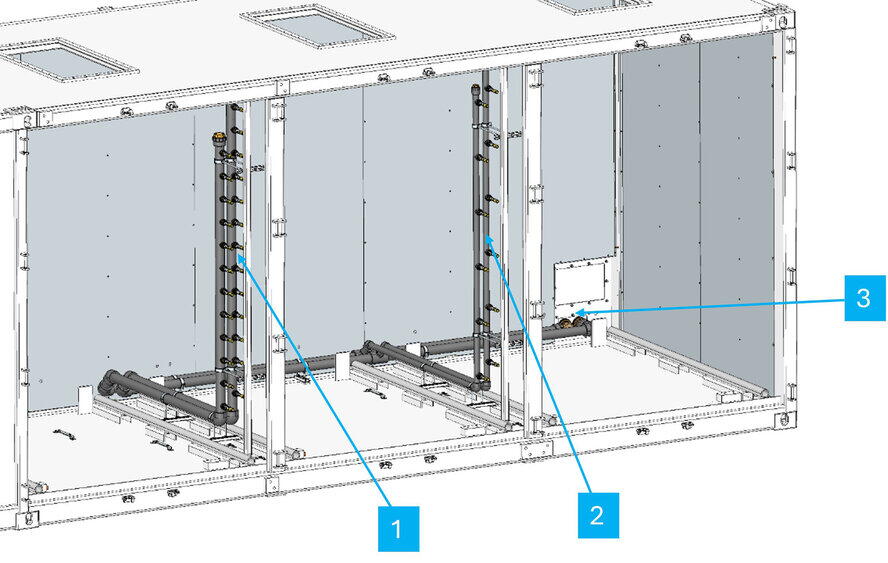
1 |
Cooling system supply and return lines for battery towers 1 and 2 |
3 |
Junction box of the cooling system distribution at the container for supply and return |
2 |
Cooling system supply and return lines for battery tower 3 |
3.3.9. Fire alarm system (FAS)
The fire alarm system is installed and checked at the factory. Maintenance and service work on the fire alarm system must only be carried out by authorized specialist personnel. Safety-relevant information can be found in the Safety section.
In the event of an alarm or malfunction, contact the FENECON service personnel.
|
NOTE To restart the system after a false alarm/fault, acknowledge the fire detection system alarm on site. |
|
NOTE Trip test alarms with test gas. Use test gas [ALL081] Test gas test aerosol 918-5 250 ml for this purpose. |
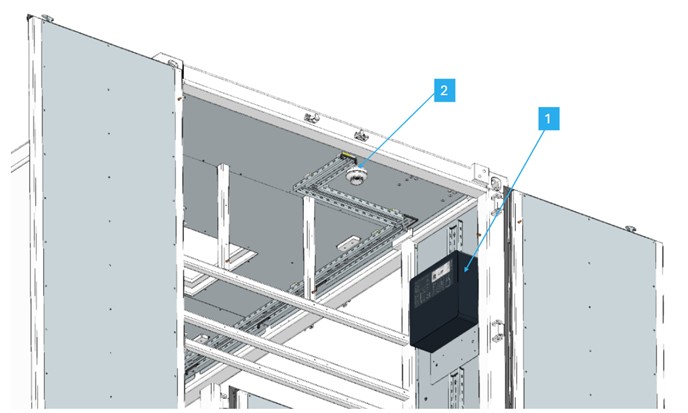
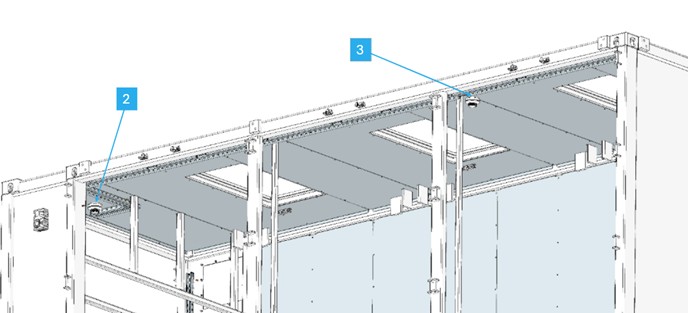
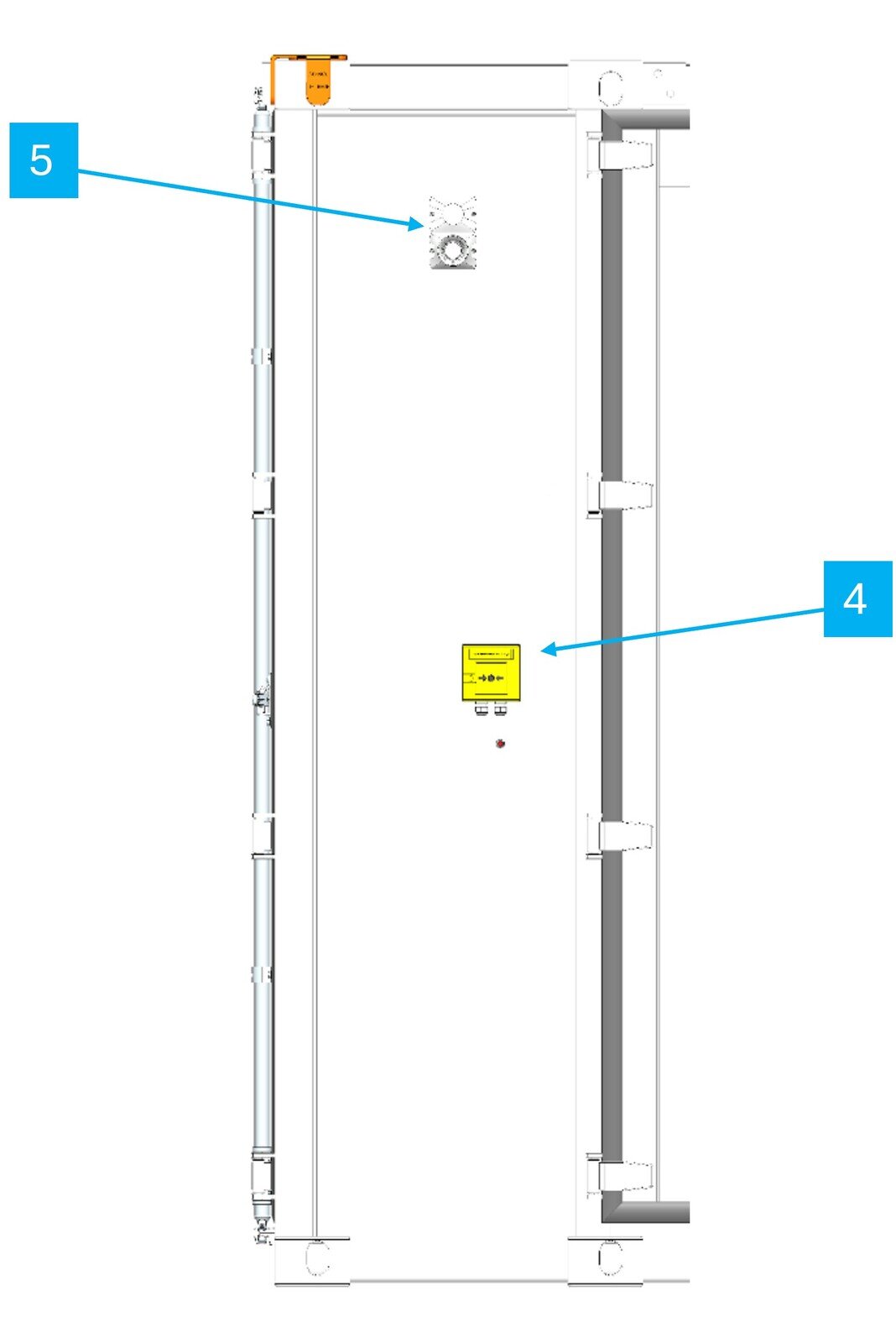
1 |
Fire alarm control unit |
4 |
Manual activation switch |
2 |
Multi-detector sensor |
5 |
Audible and visual signaling device |
3 |
Multi-detector sensor |
3.4. Inverter rack
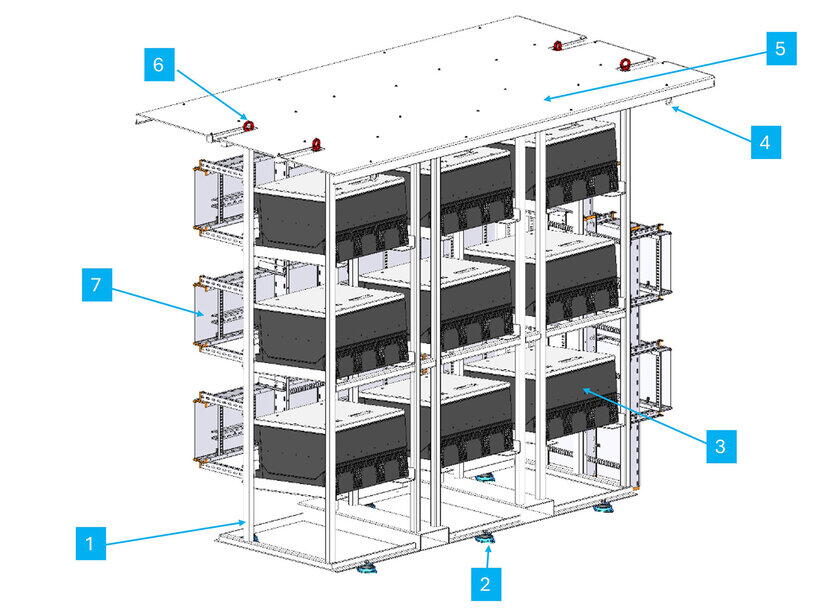
1 |
Steel frame |
5 |
Roof |
2 |
Vibration damper |
6 |
Lifting eyebolts (4 x per inverter rack) |
3 |
Inverter |
7 |
Cable ladders |
4 |
Lifting points for transportation |
3.4.1. Steel construction — Inverter rack
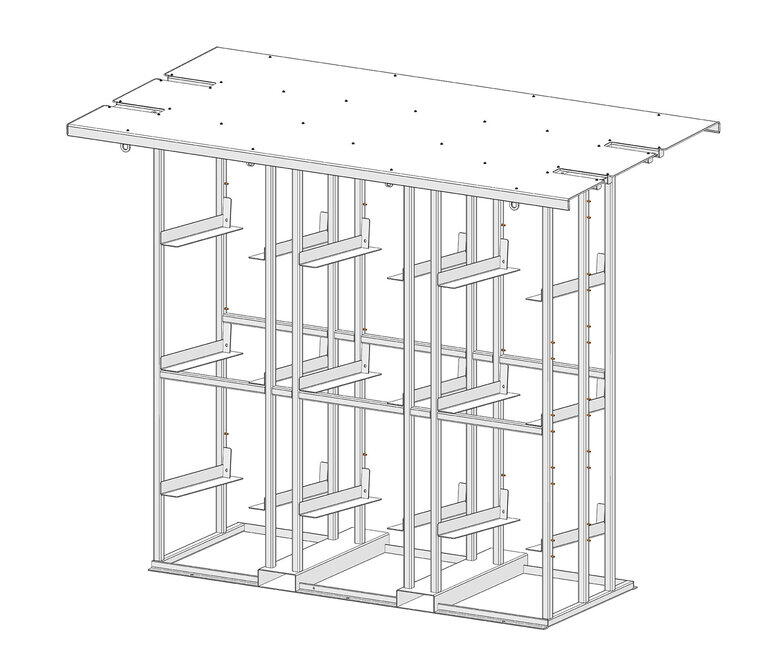
The steel construction of the FENECON Industrial XL inverter rack has been statically tested and meets all requirements.
The surface coating corresponds to corrosion protection class C4H and is finished in RAL 9010 pure white.
The weight of the steel structure is 640 kg.
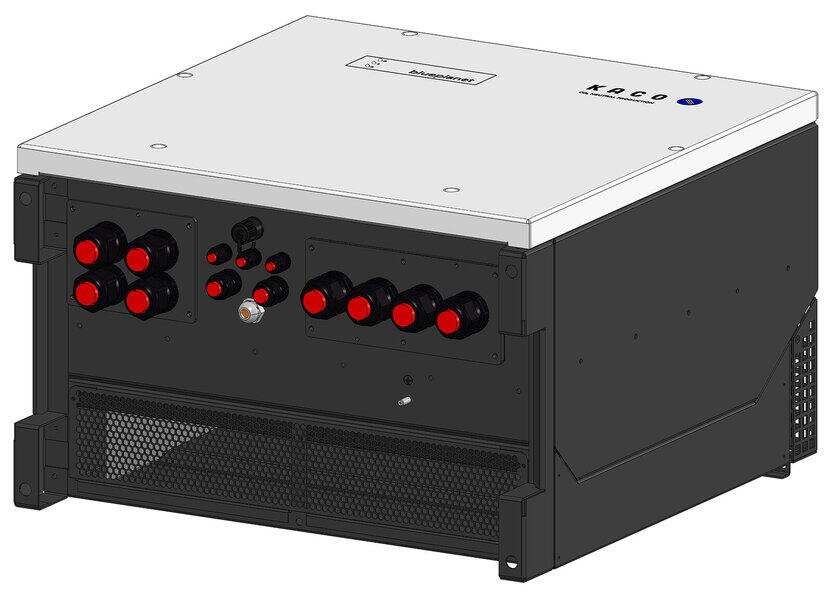
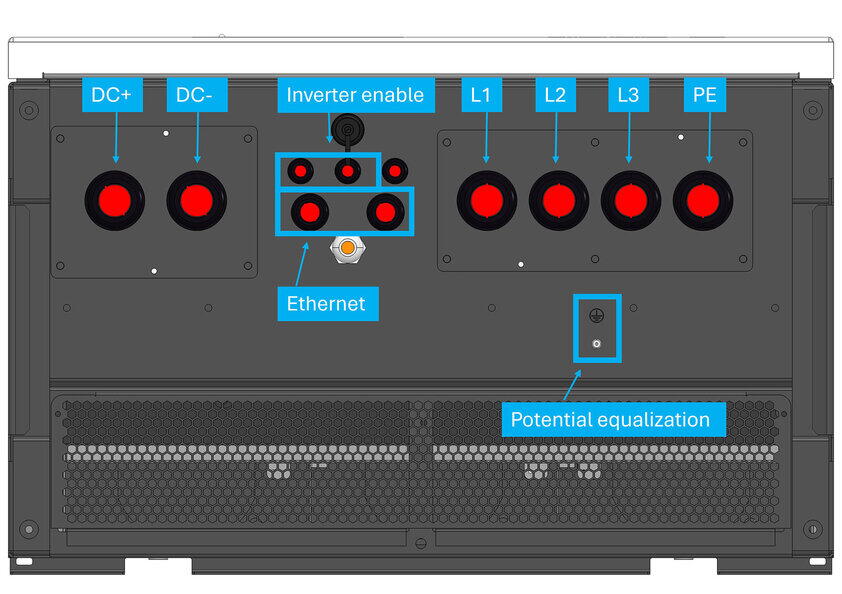
3.4.3. Cable ladder
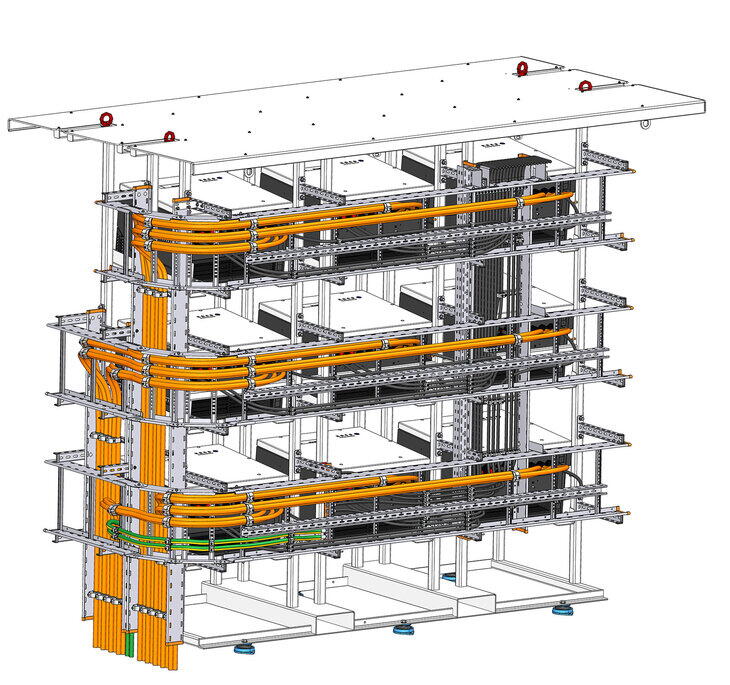
The color coding of the cables in the picture above is as follows:
-
Orange = AC cable of the customer
-
Black = DC and communication cable
-
Green/yellow = grounding cable
The DC cables are laid in the lower area of the cable ladders.
The customer’s AC cables are laid in the upper area.
-
Single wires with a maximum cross-section of 150 mm2 are permitted.
-
The cable ladder is not designed for AC feed lines in multiple cable bundles.
The side channels are intended for the customer feed of the AC cables. The middle channel is intended for the DC and communication connections to the battery container.
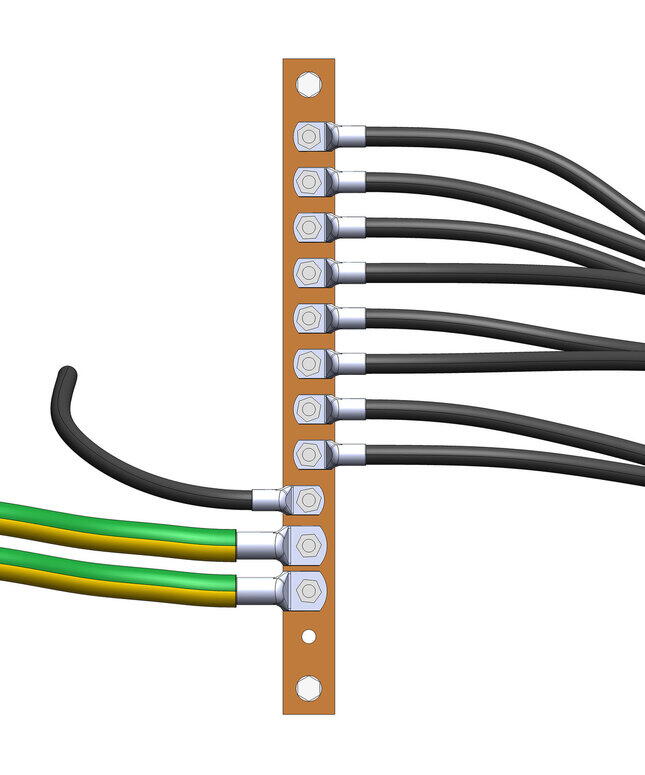
The customer can connect up to two protective conductors from the AC power supply to the equipotential bonding bar on the inverter rack (see image). Using two protective conductor cables allows the required cross-sectional area to be divided accordingly. The dual configuration of the protective conductor connections ensures redundancy and thus provides additional safety.
Anschluss an die Potenzialausgleichsschiene
Bohrungsdurchmesser |
11 mm |
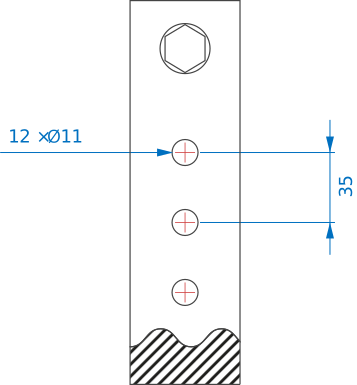
|
Abstand zwischen den Anschlussbohrungen |
35 mm |
|
Geplante Befestigung |
M10-Schrauben |
|
Maximaler Anschlussquerschnitt |
300 mm2 bei Verwendung von M10-Kabelschuhen. |
Die Anschlussleiter sind mit geeigneten M10-Kabelschuhen auszuführen und fachgerecht an der Potentialausgleichsschiene zu befestigen.
3.5. Cooling system
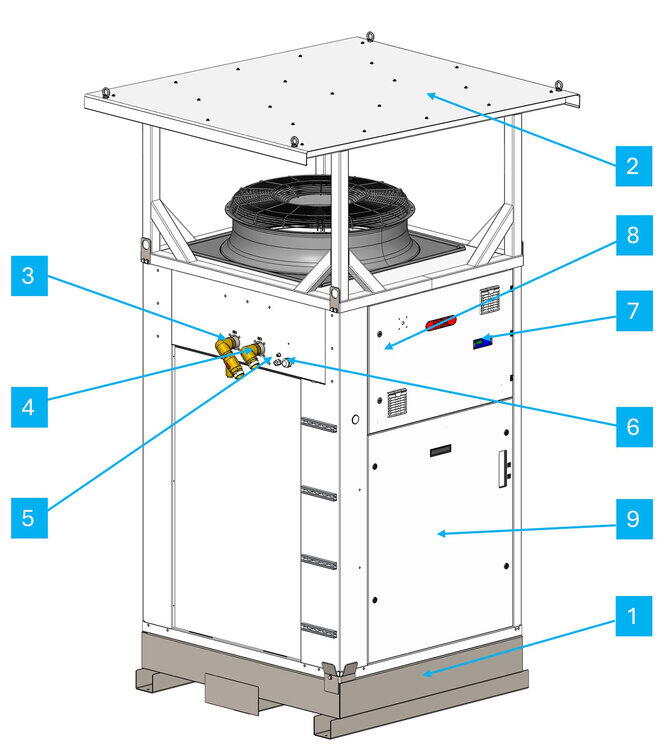
1 |
Drip tray |
6 |
Electrical interface — Power supply |
2 |
Roof |
7 |
Temperature controller |
3 |
Connection/Flow |
8 |
Main switch |
4 |
Connection/Return |
9 |
Cover plate — Maintenance access |
5 |
Electrical interface — Signal |
3.6. Cable bridges
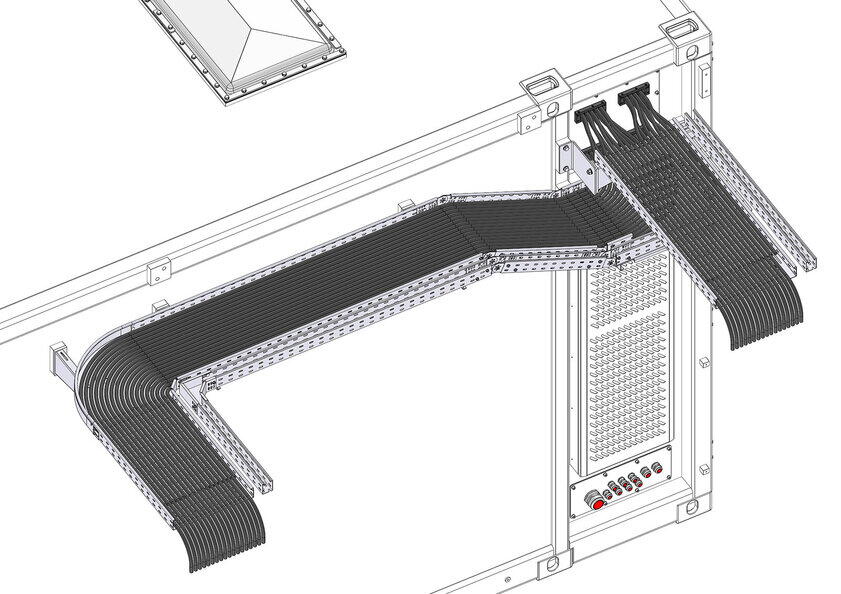
The cable bridges between the inverter racks and the container are installed by the service personnel during commissioning. The DC and communication cables of the inverter racks are routed to the inverter connection of the container via these cable bridges.
|
|
NOTICE |
|---|---|
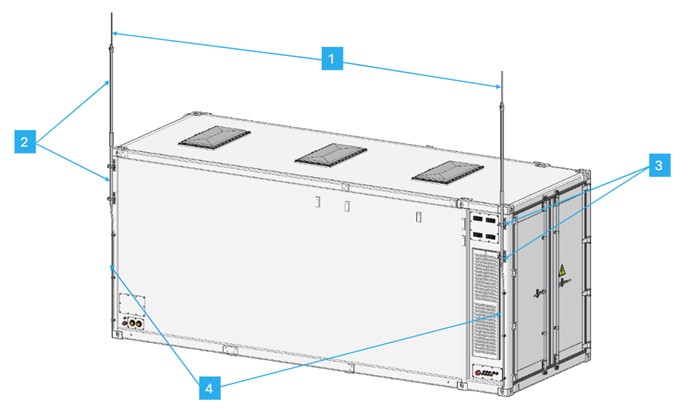
4. Assembly preparation
4.1. General description
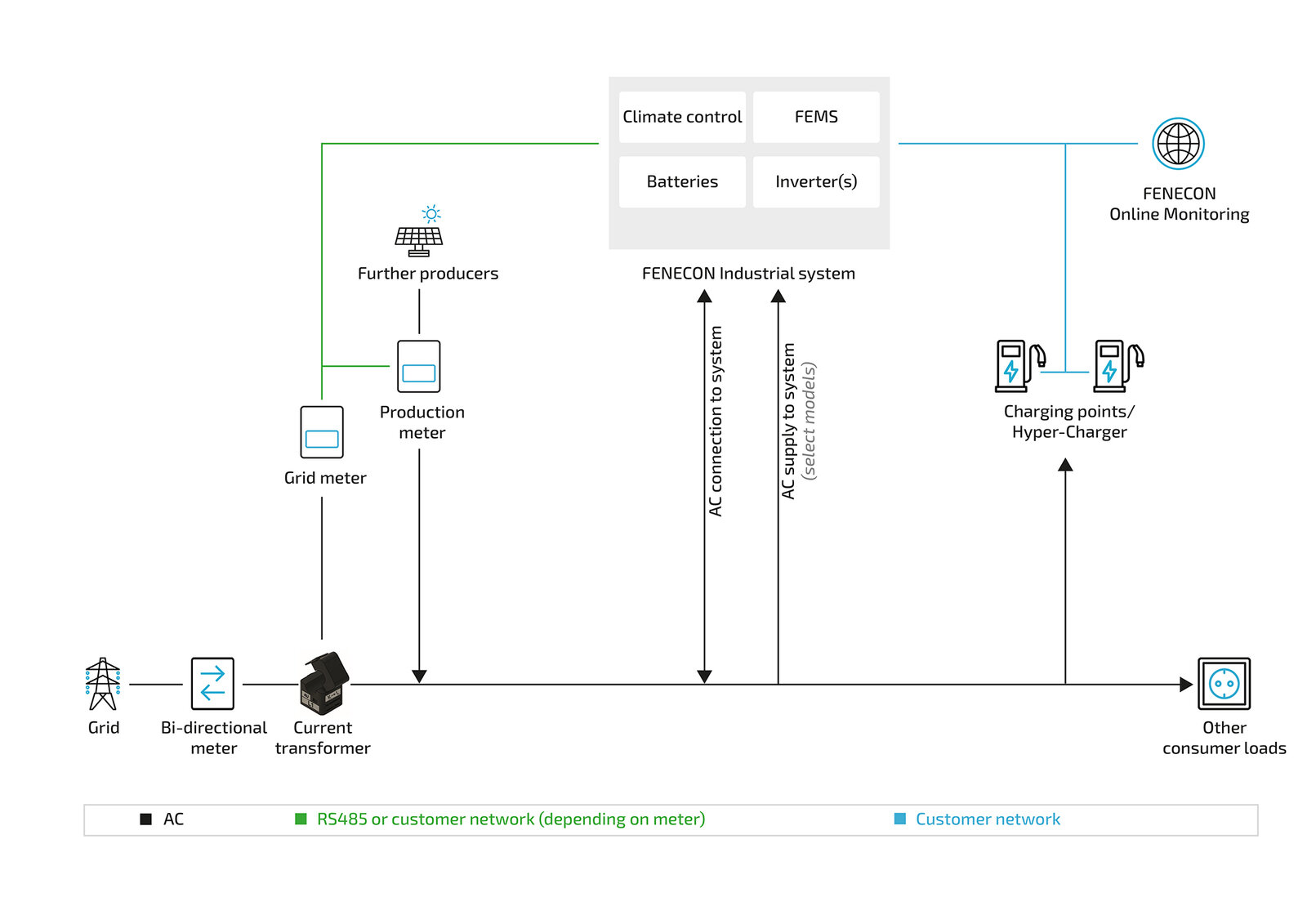
Standardized system configuration, generally valid for all FENECON industrial storage systems. Details vary depending on the electrical energy storage system. This system configuration can be an example for the application of self-consumption optimization.
Residual risks:
|
|
DANGER |
|---|---|
|
|
NOTICE |
|---|---|
4.2. Scope of delivery
| List item | Component | Amount | Item no. | Comment |
|---|---|---|---|---|
1 |
Container incl. 36 batteries, room air conditioner and cabling |
1 |
BGI0764 (pre-series) |
Transport reinforcement of the container back to FENECON |
2 |
Inverter rack front with 9 inverters each (KACO bp 92.0 TL3-S) |
1 |
BGI0387 |
|
3 |
Inverter rack climate with 9 inverters each (KACO bp 92.0 TL3-S) |
1 |
BGI0388 |
|
4 |
HYDAC cooling system |
1 |
ZUI2191 |
|
5 |
Drip tray and roof for the climate control unit |
1 |
ZUI2192 |
|
6 |
Cable jumper set inverter rack to container |
1 |
BGI0782 |
|
7 |
Cooling cable jumper set |
1 |
BGI0788 |
|
8 |
Drums with coolant (water/glycol) 220 liters each |
2 |
ZUI2841 |
Return to FENECON |
9 |
Canisters with coolant (water/glycol) 30 liters each |
1 |
ZUS830 |
Return to FENECON |
10 |
Grid box with cable bridges and hose set |
1 |
BGI0786 (pre-series) |
Return to FENECON |
Software licenses for operating the system are not included in the standard scope of delivery. The applications Read and Write Access (REST/JSON and Modbus/TCP, Self-Consumption Optimization, Peak Shaving (phase-accurate) and Time Slot Peak Shaving can be purchased optionally. These can be installed both retrospectively and directly during commissioning. The instructions for FEMS applications for the electrical energy storage system can be found at docs.fenecon.de.
4.3. Tools/machines required
The following tools are required for assembly of the system components:
| Description | Comment |
|---|---|
Crane |
Crane with chain slings |
Multimeter |
|
Socket wrench set/ratchet box |
|
Hexagon socket wrench set |
|
Measuring tape/measuring device for setting up the components |
|
Toolbox for electrician |
5. Assembly — General
The AC connections and inverters are assembled and installed by the operator. Please make an appointment in advance with your contact person at FENECON for the subsequent commissioning.
FENECON GmbH
Gewerbepark 6
94547 Iggensbach
GERMANY
+49 (0) 9903 6280 0
aftersales.industrial@fenecon.de
Residual risks:
|
|
DANGER |
|---|---|
|
|
NOTICE |
|---|---|
The following components must be installed or connected by the operator:
-
Container
-
2 inverter racks with 9 inverters each
-
Cooling system
|
NOTE Before installation, check carefully whether the products are damaged and whether all accessories listed in the scope of delivery are included. If a part is missing or damaged, contact the manufacturer/dealer. |
5.1. Select installation site
5.1.1. Installation site
-
Install the system outdoors.
-
Avoid dirt and dust during assembly.
-
Do not install the electrical energy storage system in an area that is at risk of flooding.
-
Do not install the electrical energy storage system where the ambient conditions are outside the operating requirements.
(Max. 2000 m above sea level — For more information see: Section: Technical data). -
Keep the batteries away from heat sources and fire.
-
The electrical energy storage system must be set up in such a way that only authorized personnel have access to it.
The operator of the system is responsible for selecting and preparing a suitable installation site for the energy storage system. It must be ensured that the ground is suitable for the use of a crane. The lifting instructions must be observed for the design of the crane and the lifting beam. Sufficient clearance must also be ensured in front of the container. The requirements for the installation site from the FENECON installation concept must be met.
The BESS FENECON Industrial XL must be installed and operated outdoors.
5.2. Assembly steps
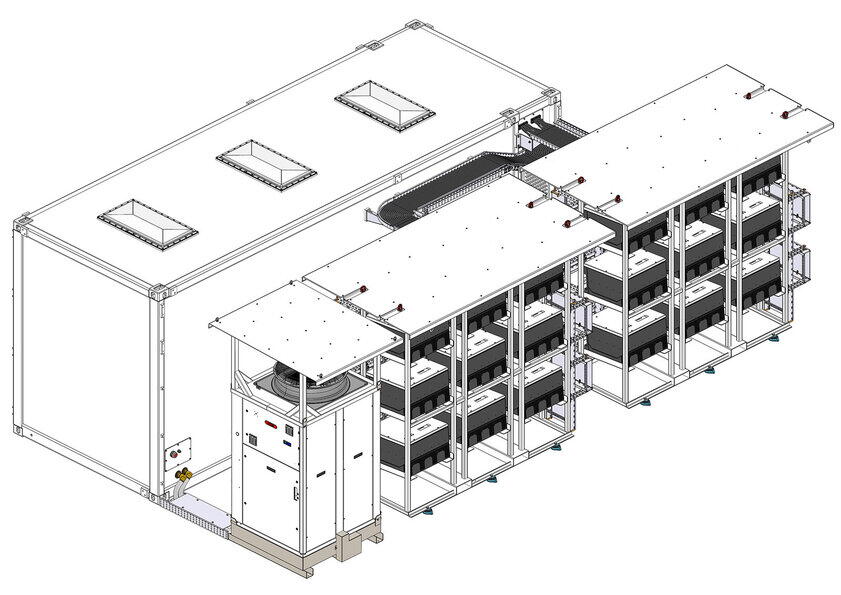
|
|
NOTICE |
|---|---|
5.2.1. Unload container
-
Use a crane to unload the container.
-
Beachten Sie unbedingt die Hebeanweisung für das Abladen des Containers.
-
Observe the foundation and load transfer recommendations for placing the container.
5.2.2. Unloading the inverter racks
-
Use a crane to unload the inverter racks.
-
Beachten Sie unbedingt die Hebeanweisung für das Abladen der Wechselrichtergestelle.
-
Observe the foundation and load transfer recommendations for positioning the inverter racks.
5.2.3. Positioning and setting up the liquid cooling system
-
Use a crane to unload the HYDAC cooling system.
-
Always follow the manufacturer’s lifting instructions for unloading the HYDAC cooling system! See Applicable documents.
-
Observe the foundation and load transfer recommendation for positioning the HYDAC cooling system.
5.3. Setting up the system
-
Set up and align the drip tray.
-
Place the HYDAC liquid cooling system on the drip tray.
-
Install the roof on the liquid cooling system.
5.3.1. Install equipotential bonding/earthing
An earthing connection can be made to the container and the inverter racks. The electrical energy storage system must be integrated into the on-site lightning protection concept and the corresponding earthing and equipotential bonding cables must be connected to the marked points. The instructions in the installation concept must be observed.
6. Network connection
The network connection and communication to FENECON Industrial XL is implemented as follows by default:
6.1. Standard setup — Internet via fiber optics
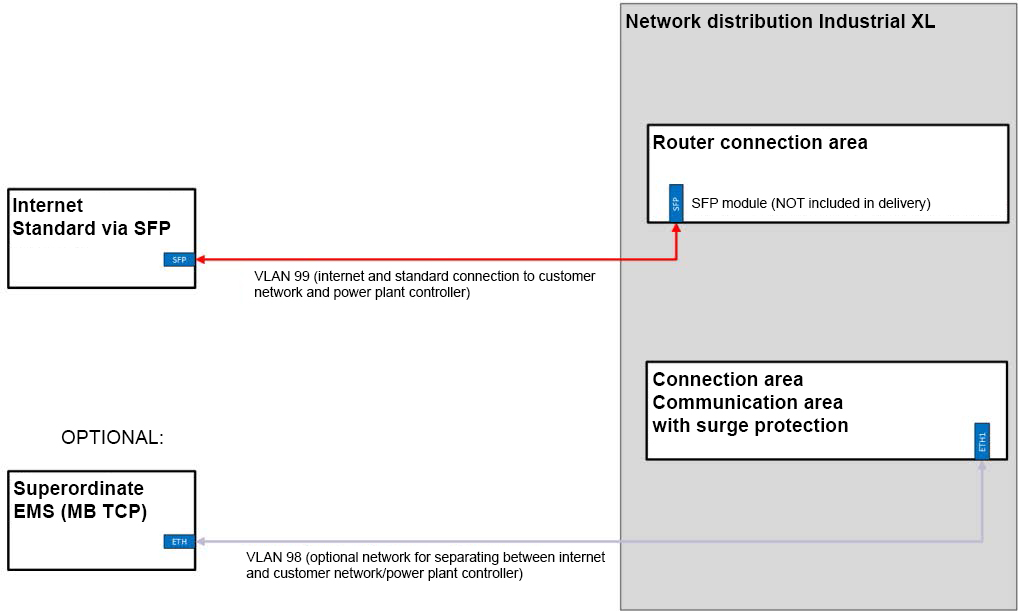
Internet — Standard via SFP: Only one connection via optical fiber is required. The internet connection must be established in accordance with the information in the section Technical documentation FEMS. Communication with the power plant controller and controller of the energy storage system is also implemented via this interface as standard.
The SFP+ module for the fiber optic connection must be provided by the customer. For technical queries or further coordination, please contact FENECON project management.
Superordinate EMS (MB TCP): If the internet connection is to be separated from the rest of the network, establish a physical separation via a second Ethernet connection. This allows the energy storage system to be integrated into a local network without having to establish an internet connection.
The separate internet connection is still necessary!
6.2. Internet via ETH
If the internet connection is not to be established via fiber optic, but via Ethernet, it is necessary to purchase the additional package "Internet via ETH". This consists of an additional overvoltage protection, an ETH/SFP module and an additional connection cable. These components must be installed according to the Industrial XL instructions. Please note the maximum cable length of the option.
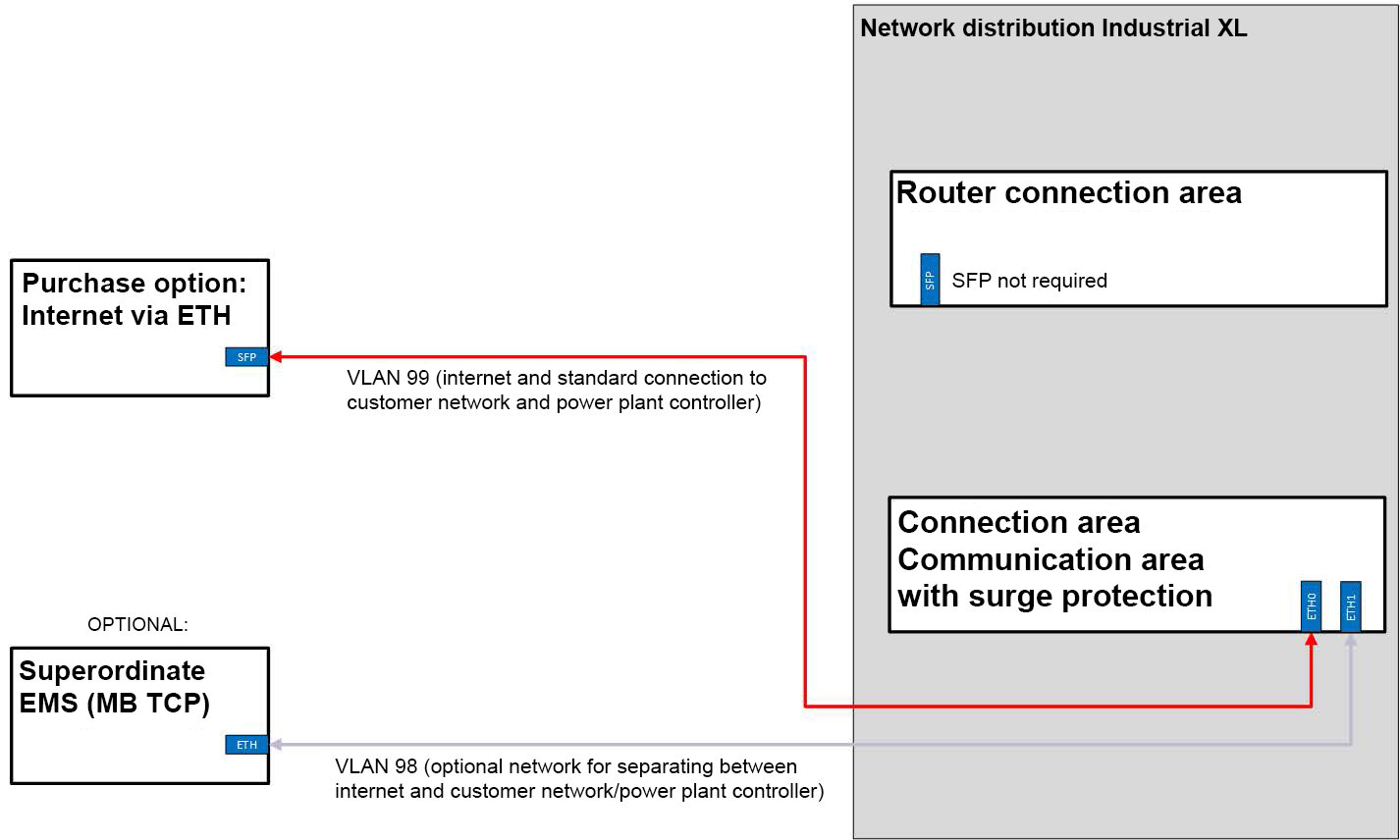
The option Superordinate EMS (MB TCP) remains unaffected by this and can be set up in the same way as in the previous section.
6.3. General information
-
There is no option to provide the internet via a SIM card to be integrated.
-
An unrestricted internet connection is required to ensure optimal operation.
-
The maximum cable lengths of the supply lines used must always be observed.
-
The Ethernet cable must NOT be connected directly to the system router, only SFP!
-
The system is operated with the FEMS App Modbus/TCP write access by default.
7. Initial commissioning
The initial commissioning is carried out by FENECON GmbH. Please arrange an appointment for commissioning in advance with your contact person at FENECON GmbH.
FENECON GmbH
Gewerbepark 6
94547 Iggensbach
GERMANY
+49 (0) 9903 6280 0
aftersales.industrial@fenecon.de
Residual risks:
|
|
DANGER |
|---|---|
|
|
NOTICE |
|---|---|
8. FEMS — FENECON Energy Management System
8.1. Technical documentation — FEMS
The technical documentation of FEMS must be observed; this can also be found on the FENECON website at: www.docs.fenecon.de/en.
-
Internet connection
A permanent internet connection for the FEMS is recommended and is necessary for commissioning. In principle, offline operation is also possible. In this case, however, the following functions cannot be used:
Remote commissioning, system updates, installation of new FEMS Apps, transfer of measurement data to FENECON servers for remote access, use of Online Monitoring via the FENECON portal access (e. g. for on the go via smartphone), maintenance access for FENECON Service employees, use of FEMS Apps with third-party services via the internet (e. g. Time-of-use tariffs).
-
Network configuration
In the standard configuration, FEMS obtains the IP address via a DHCP server (e. g. FritzBox). The network configuration can also be adjusted in Online Monitoring under Settings & Network configuration. More information can be found here.
-
System update
The system is regularly updated as part of software updates. These updates can be installed via the Settings & FEMS system update tab.
8.2. Online Monitoring
The FEMS Online Monitoring is used to visualize all energy flows in the system. The energy monitor shows live data on grid withdrawal or grid feed-in, PV production, charging/discharging of the battery storage system and electricity consumption. Other widgets show the percentage of self-sufficiency and Self-consumption. In addition, the individual widgets offer a detailed view, which can also be used to view the performance values with phase accuracy.
In addition to the pure information display, Online Monitoring also lists all additionally purchased FEMS extensions, such as phase-accurate Peak Shaving, self-consumption optimization, Time Slot Peak Shaving. Their functionality can be controlled via the corresponding widget. The integration of a PV system or other generators is also possible with the FEM112 package.
In addition to the live view, the history offers the option of selecting self-selected time periods for Online Monitoring.
The status of both the overall system and the individual components can be monitored at any time using the info icon.
Die Technische Dokumentation des FEMS muss beachtet werden. Diese ist auf docs.fenecon.de verfügbar.
8.3. Access data
Access to FEMS Online Monitoring is separated according to end customer and installer.
8.4. Overview
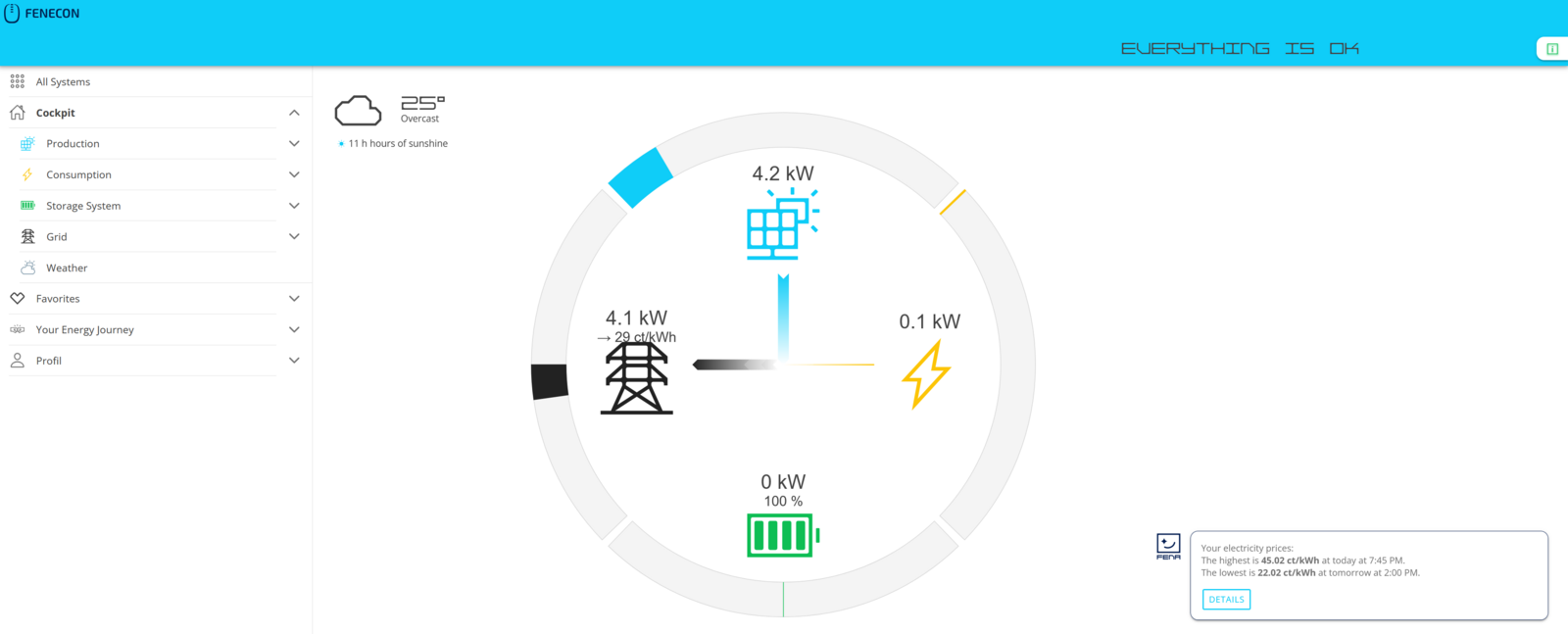
Die Dokumentation zum Monitoring der FENECON App finden Sie hier auf docs.fenecon.de.
9. Troubleshooting
Residual risks:
|
|
NOTICE |
|---|---|
9.1. FEMS Online Monitoring
The system status can be checked after logging in at the top right using the color of the icon.
9.1.1. Fault display

|
System status: Everything is OK |

|
System status: Warning |

|
System status: Error (Fault) |
9.1.2. Troubleshooting
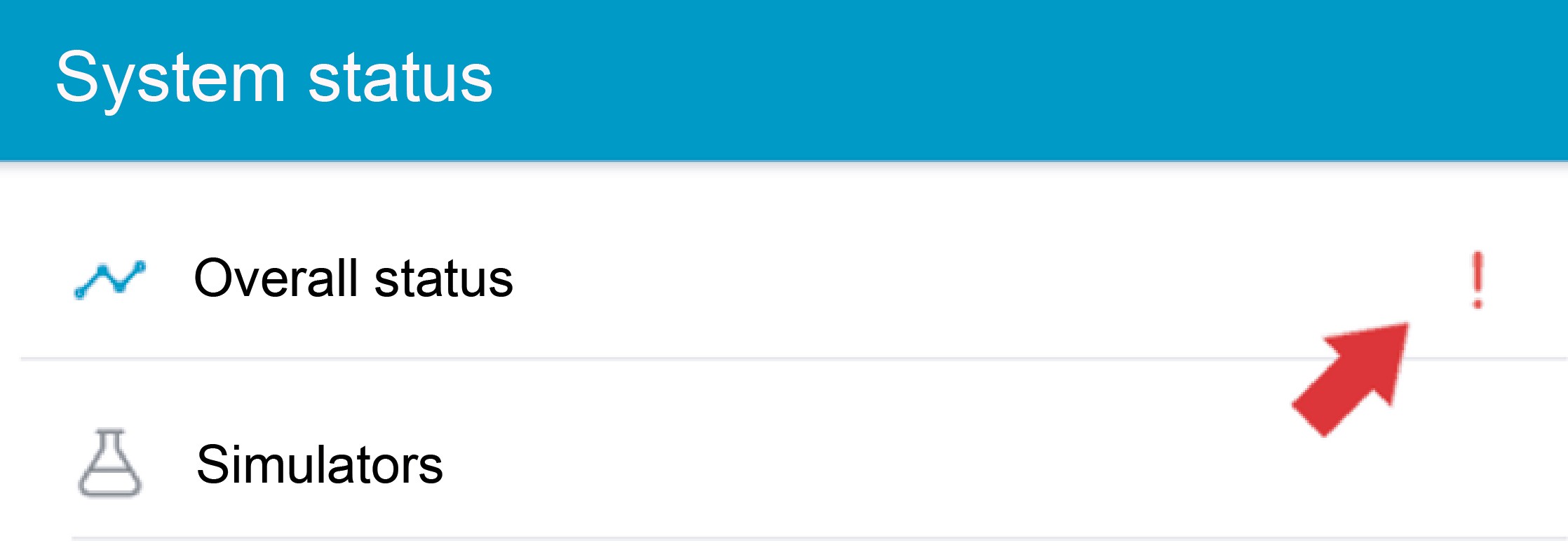
|
For a detailed overview of an existing warning or error, click on the exclamation mark in the top right-hand corner. |
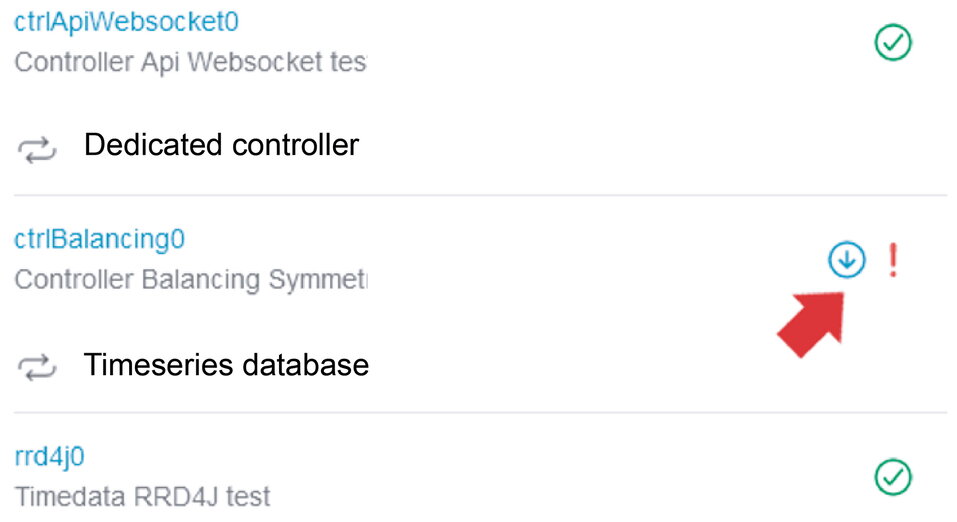
|
You can use the scroll bar to examine the origin of the warning or error in more detail. |
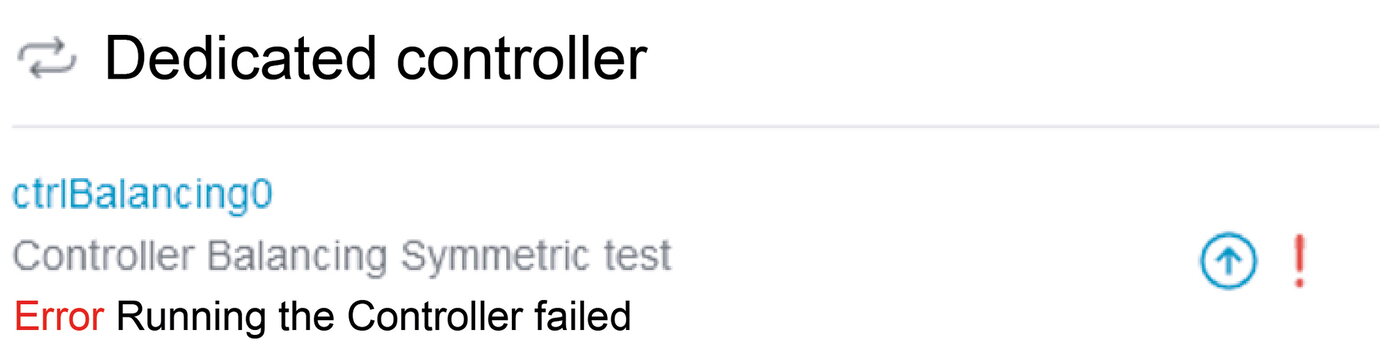
|
Clicking on the icon (down arrow) displays a more detailed error description depending on the error. |
In the example above, an incorrect reference for the grid meter was intentionally entered for test purposes, which is why the controller execution fails.
The FENECON Service must be contacted to rectify errors.
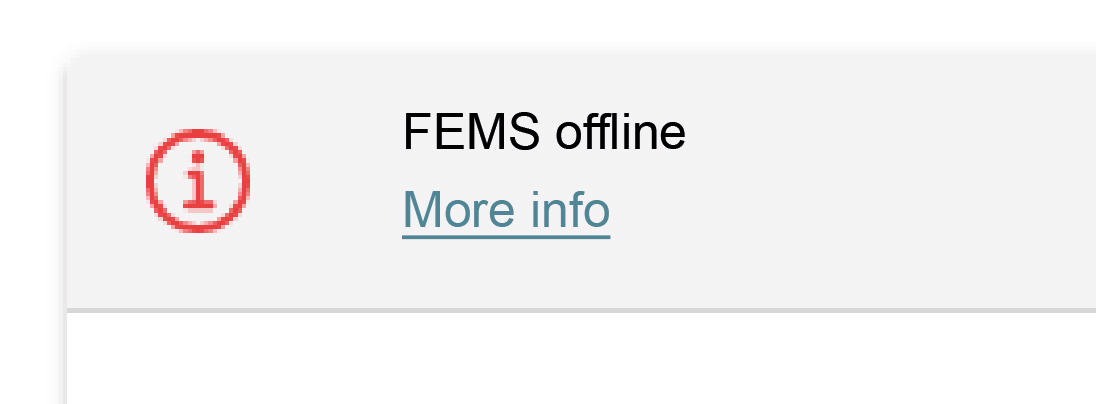
|
Under certain circumstances, the FEMS may not be accessible and the adjacent error message may appear. |
If the FEMS is offline, follow the steps displayed below the message.
9.2. FENECON Service
These installation and service instructions only contain work that can be carried out without specialist knowledge of the manufacturer.
Work that is not described must only be carried out by authorized service personnel. Contact customer service to change parameters and programs.
If the energy storage system malfunctions, contact the FENECON Service:
Phone: +49 (0) 9903 6280 0
E-mail: aftersales.industrial@fenecon.de
9.2.1. Details for the FENECON Service
The following information must be provided for the FENECON Service:
-
Device type/configuration.
-
FEMS number.
-
Serial number.
-
The currently installed software version.
-
Ticket number from previous faults (if available).
-
Inverter error code (if available).
The information can be found on the type label and in the system profile in Online Monitoring.
10. Technical maintenance
10.1. Tests and inspections
|
|
WARNING |
|---|---|
Check the product and the cables regularly for visible external damage. If components are defective, contact the FENECON Service. Repairs must only be carried out by a qualified electrician.
10.3. Maintenance work
Residual risks:
|
|
DANGER |
|---|---|
|
|
DANGER |
|---|---|
|
|
NOTICE |
|---|---|
The frequency of use and environmental conditions can make it necessary to vary the intervals between the activities described below.
-
Instruct the persons responsible for maintaining the product.
-
After consulting the manufacturer, change the maintenance intervals in this documentation.
For maintenance of the inverters and the liquid cooling system, please refer to the documentation of the individual manufacturers and the FENECON maintenance instructions.
11. Storage
Nach 3 Monaten: Trockenbeutel ersetzen
Zur Vermeidung von Kondensatbildung im Container während der Lagerung werden Trockenbeutel eingesetzt.
There are six desiccant bags in the container on delivery. Replace the saturated desiccant bags with new ones after a storage period of three months and after the container has been open for more than 30 minutes in high humidity or rain.
Remove the desiccant bags after commissioning.
Nach 6 Monaten: Beladung der Batterien prüfen und ggf. Zwangsbeladung
Mögliche Folgen: Tiefentladung der Zellen und Defekt der Batterie.
-
External charging of the battery modules to rated voltage — forced charging must be performed, which is controlled via the FEMS.
This must only be carried out by the manufacturer or by a company commissioned by the manufacturer.
-
Do not store the energy storage system together with flammable or toxic objects.
-
Store energy storage systems with safety defects separately from undamaged systems.
-
The SoC of the individual batteries in the energy storage system is ≥ 25% SoC on delivery.
-
The SoC of the individual batteries should be within a range of 25 to 75 %. If this is not the case, charge or discharge the batteries accordingly.
-
Recharging the batteries is recommended from an SoC of <25 %.
Storage area: Fireproof indoors/outdoors with suitable weather protection
-
Air temperature: -20 °C to 40 °C.
-
Relative humidity: max. 50 % at +40 °C.
11.1. Commissioning instructions — Room air conditioning
Rev. 01 — Status: October 2025
11.1.2. Installation site
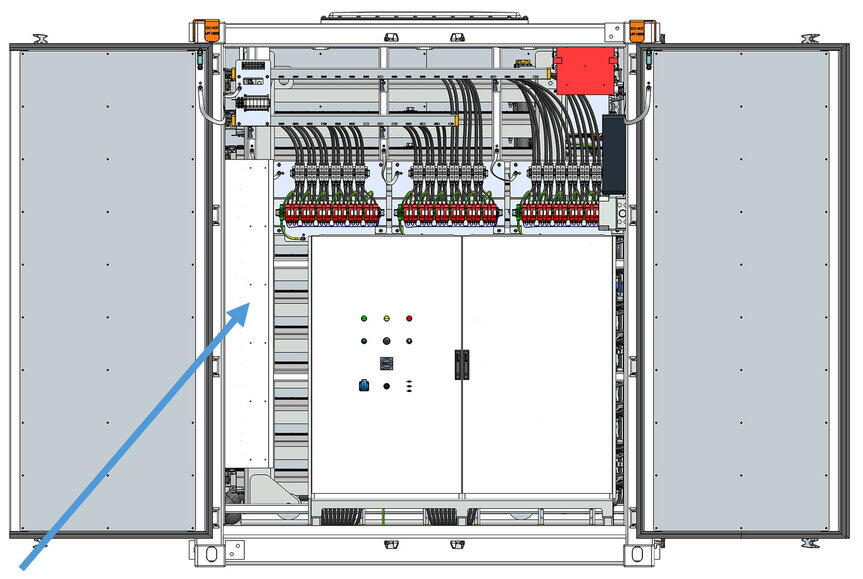
-
Open the front of the container for installation.
-
The cooling system is located on the left-hand container wall.
11.1.3. Electrical connection
-
Use a UV/weather-resistant cable with a cross-section of 5 x 1.5 mm2 or 5 x 2.5 mm2 for the electrical connection.
-
Fuse protection is provided by a three-pole miniature circuit breaker with a B16 A characteristic on the customer side.
-
-
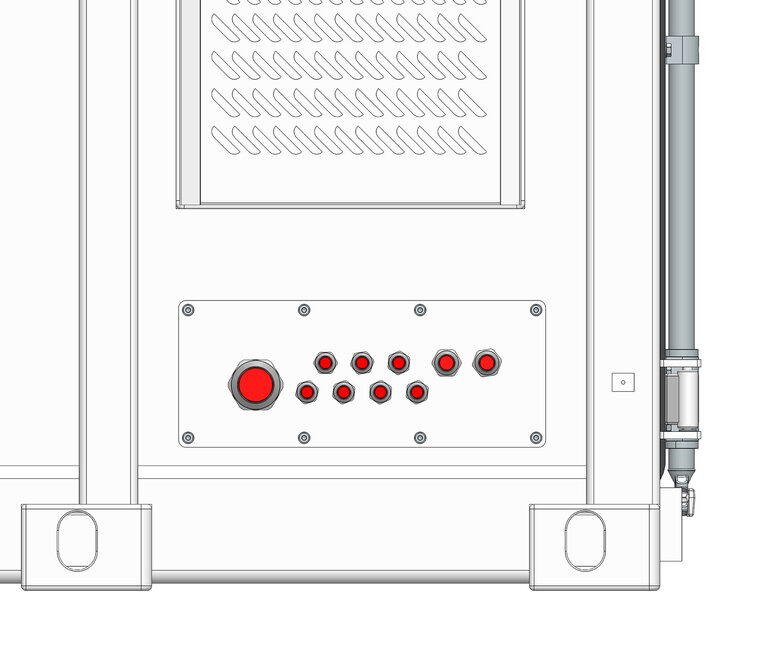
Feed the connection cable into the container underneath the cooling system via a cable gland on the flange plate.
-
Locate terminal X1 on the device.
-
Prepare the room air conditioning for connection.
-
Connect the room air conditioning to terminal X1.
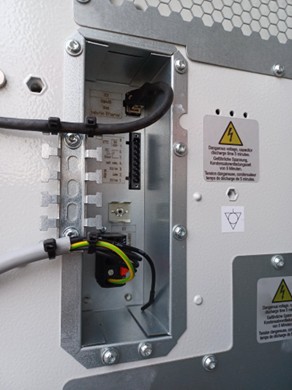
After the miniature circuit breaker has been racked in, the device automatically starts operation. Manual operation is not required.
12. Utilization load
The service life of the product depends on the service life and maintenance intervals carried out by specialist personnel. The service life is particularly influenced by preventive maintenance and servicing. Timely replacement of wearing parts and appropriate documentation of each activity is therefore crucial for the availability of the product.
All functional safety elements must be replaced in accordance with the number of operating cycles or operating time specified by the manufacturer before the calculated or specified service life is reached.
The manufacturer must be contacted after 20 years at the latest in order to determine the further procedure with regard to revision or replacement.
13. Transport
This section contains information on external and internal transportation of the product.
Transportation is the movement of the product by manual or technical means.
-
Only use suitable and tested lifting gear and hoists for transportation!
-
The product must only be transported using the means of transport specified by the manufacturer.
-
Use the specified transport reinforcements.
Residual risks

|
DANGER |
|---|---|
|
|
DANGER |
|---|---|
|
|
DANGER |
|---|---|
|
NOTE Check that the parts and outer packaging are in perfect condition. |
Legal regulations
The off-site transportation of the product is carried out in accordance with the legal regulations of the country in which the product is transported off-site.
13.1. Safety instructions
-
Transportation is carried out by a hazardous goods carrier.
-
When transporting batteries, the applicable laws, regulations and standards (e. g. Dangerous Goods Transportation Act — GGBefG) must be complied with.
All necessary authorizations and documents, such as a special permit and a dangerous goods driver’s license (ADR certificate), must be available.
It must also be ensured that sufficiently tested lashing equipment is available. -
Upon receipt, check the delivery immediately for completeness and transport damage.
-
Use personal protective equipment (depending on the boundary conditions) (minimum requirement: protective headgear and protective footwear).
-
Disconnect the electrical connections before transport.
-
Before lifting, check that the attachment points and lifting gear are correctly seated.
-
The container should only be transported with a SoC of min. 25 % and max. 50 %.
-
Observe the detailed lifting instructions for correct transportation.
-
The load capacity must be dimensioned so that the mass of the product can be safely accommodated.
-
The size of the transport surface must be dimensioned so that the product can be safely placed and secured on the transport surface.
13.2. Change of location
It is not intended to relocate the system after commissioning.
If a change of location is planned, consult FENECON GmbH beforehand.
The FENECON Industrial XL, fully equipped with battery packs, has a weight of approx. 32,000 kg.
13.3. Transportation process
Means of transportation
A means of transport that meets the following requirements is needed for safe off-site transportation:
-
The load capacity must be dimensioned so that the mass of the product can be safely accommodated.
-
The size of the transport platform must be dimensioned so that the product can be placed safely on the transport platform without falling.
Required aids
The following aids are required for safe off-site transportation:
-
Loading and unloading: Use a crane. Only lift the fully-equipped Industrial XL container using the transport reinforcements provided.
-
Transportation: only by motor vehicle for road transport.
Lifting instructions
-
A crane with a minimum load capacity of 32 tons is required to transport a fully-equipped Industrial XL.
-
When lifting the electrical energy storage system, the Lifting instructions specified by the manufacturer must be observed.
-
Information on weight, center of gravity and dimensions are found in the dimensions and mass sections.
14. Dismantling and disposal
|
|
DANGER |
|---|---|
14.1. Safety instructions
-
The following suitable personal protective equipment must be worn for all work:
-
Protective footwear.
-
Protective gloves, cut-resistant if necessary.
-
Protective eyewear.
-
-
Only have the electrical energy storage system dismantled by authorized electricians.
-
Dismantling work must only be carried out when the system has been taken out of operation.
-
Before starting disassembly, all components to be removed must be secured against falling, tipping over or moving.
-
Dismantling work must only be carried out when the system is shut down and only by service personnel.
-
The existing attachment points must be used for the system parts to be transported.
-
Observe the disassembly instructions of the component manufacturers (Appendix, Applicable documents).
-
The batteries are removed by service personnel and transported by a hazardous goods carrier.
-
When transporting the battery modules, observe the current laws, regulations and standards (e. g. German Dangerous Goods Transportation Act (GGBefG)).
14.2. Prerequisites

|
CAUTION |
|---|---|
Before dismantling, disconnect the power supply to the system and secure it against being switched on again.
14.3. Disposal
-
Observe the local regulations and information in the safety data sheets for the disposal of auxiliary and operating materials.
-
For disposal, please also observe the information in the individual operating instructions for the respective components.
-
If in doubt about the disposal method, contact the manufacturer or the local waste disposal company.
14.3.1. Individual parts
After proper disassembly, the dismantled individual parts must be recycled:
-
The electrical energy storage system must not be disposed of with normal household waste.
-
Scrap metallic materials.
-
Send plastic elements for recycling.
-
Dispose of the remaining components sorted according to material properties.
Electrical waste, electronic components, lubricants and other auxiliary materials are subject to hazardous waste treatment and must only be disposed of by authorized specialist companies.
14.3.2. System
Also observe the following points when disposing of the electrical energy storage system or its components as well as the operating and auxiliary materials:
-
Comply with local national regulations.
-
Observe company-specific specifications.
-
Dispose of operating and auxiliary materials in accordance with the applicable safety data sheets.
-
Dispose of the packaging material in an environmentally friendly manner.
Batteries
-
Do not expose the battery modules to high temperatures or direct sunlight.
-
Do not expose the battery modules to high humidity or corrosive atmosphere.
-
Obtain special instructions on the disposal of used batteries by contacting the FENECON Service.
16. Register
16.1. Applicable documents
|