Supplement to the Ordinance on
Installations for Handling Substances Hazardous to Water (AwSV)
1. About this document
Version: REV. 01 — Jun. 2026
Dieses Beiblatt ist in Zusammenarbeit mit einem AwSV-Sachverständigen der Sachverständigenorganisation Ibis Umwelttechnik erstellt worden.
2. Beschreibung des Batteriespeichers und der Rückhalteeinrichtungen
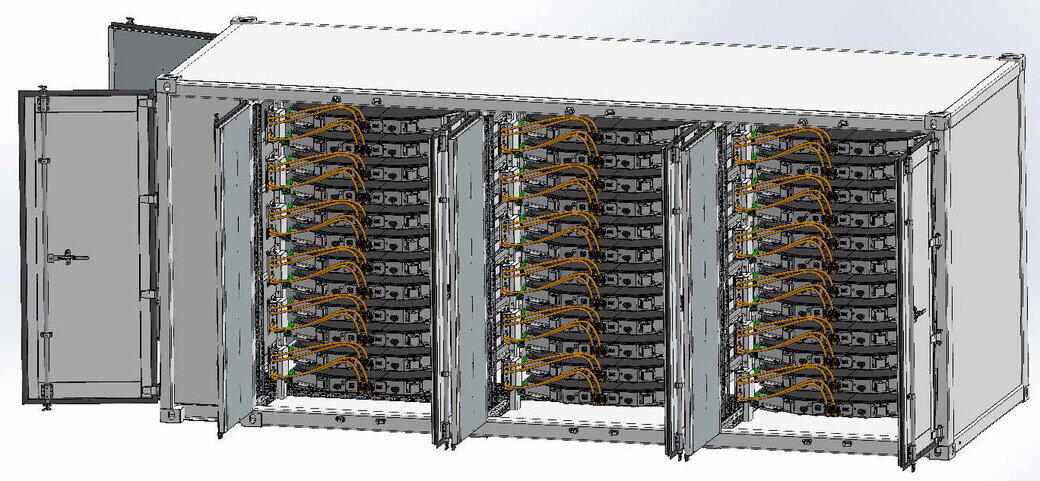
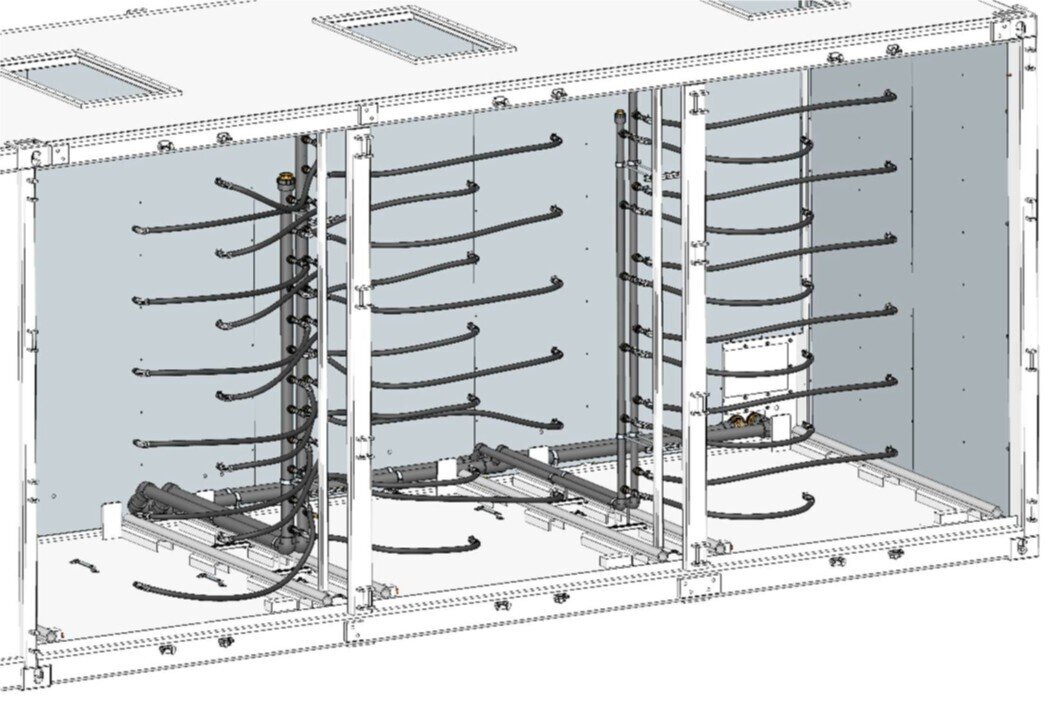
Der Batteriespeicher FENECON Industrial XL dient zur Zwischenspeicherung von Strom, z. B. von überschüssigem Strom, der von PV-Anlagen erzeugt wurde, und der bei Bedarf wieder abgegeben werden kann. Die Speicher befinden sich in einem 22-Fuß-Stahlcontainer, in dem die Automobilbatterien (NMC-Batterien) untergebracht sind. Diese Batterien sind Beispiele, es können auch andere Batteriemodelle verbaut werden, das Beispiel beinhaltet die bisher größtmöglichen Batterien (worst-case). Insgesamt befinden sich in dem Batteriecontainer 3 Batterie-Racks mit je 12 Batterie-Packs. Ein Batterie-Pack, mit einem Gewicht von 585 kg, beinhaltet 204 NMC-Zellen (ca. 2,9 kg). Links im Batteriespeichercontainer befindet sich die Steuereinheit. Ein verbautes Aerosol-Löschsystem schützt im Brandfall. Der Batteriespeicher verfügt über ein integriertes Kühlsystem, welches für die aktive Kühlung der Komponenten sorgt. Das Kühlsystem besteht aus einem Kühlmittelkreislauf (Wasser-Glykol-Gemisch) sowie einem Kältemittelkreislauf (gasförmiges R513A). Alle Komponenten des Kühlsystems sind innerhalb des Batteriecontainers verbaut, dabei wird die Kühlflüssigkeit vom externen Klimagerät über Transferleitungen durch zwei Kühlflüssigkeitsanschlüsse in den Batteriecontainer geleitet. Im Inneren verteilt sie sich über die Hauptleitungen, die entlang der Containerrückwand verlaufen. Von der Hauptleitung führen drei Abzweigleitungen zu den Stegleitungen des jeweiligen Batterie-Racks. Im Inneren des Batteriespeichercontainers sowie innerhalb des externen Klimageräts ist eine Auffangwanne integriert. Beide Auffangwannen dienen als Sperre für auslaufendes Wasser-Glykol-Gemisch.
3. Einstufung der enthaltenen, wassergefährdenden Stoffe
3.1. Batteriezelle
In einer einzelnen NMC-Zelle sind wassergefährdende Stoffe der WGK 1, WGK 2 sowie der WGK 3 und nicht-wassergefährdende (nwg) Stoffe enthalten. Die verwendeten Batteriezellen bestehen aus bis zu 40 % Massenanteil NMC (CAS: 346417-97-8, Rigoletto Kenn-Nr. 10186, WGK 3), damit liegt der WGK 3 Anteil oberhalb von 3 % gem. Anlage 1 AwSV und es ergibt sich die WGK 3 für die Batteriezellen. Nach Herstellerangaben bestehen die verbauten NMC-Batteriezellen zu bis zu 15 % des Massenanteils aus flüssigem Elektrolyten, wovon > 90 % in den Zellen gebunden vorliegt. Eine Zelle beinhaltet max. 0,45 l Elektrolyt (15 %), daher sind max. 3,2 m3 Elektrolyt im Gesamtsystem enthalten.
3.2. Cooling system
Im Kältemittelkreislauf wird das gasförmige Kältemittel R513A (12 kg) verwendet. Das Kältemittel ist eine Mischung aus R134A (WGK 1 gem. Rigoletto Kenn-Nr. 2350) und R123yf (WGK 1 gem. Rigoletto Kenn-Nr. 7910). Somit ergibt sich für das Gemisch die WGK 1 (> 3 % WGK 1 im Gemisch). Zur Übertragung der Wärme aus den Komponenten (Batterien, Steuerung, etc.) wird ein 450 Liter umfassender Wasser-Glycol-Kreislauf verwendet, dieser beinhaltet eine 50:50-Mischung aus Ethylenglycol (Rigoletto Kenn-Nr: 47, WGK 1) und Wasser (nwg), weshalb sich WGK 1 für das Gemisch ergibt (> 3 % WGK 1 im Gemisch). Batteriecontainer selbst. Die 450 Liter des Wasser-Glykol-Gemischs setzen sich zusammen aus einem Tank im externen Klimagerät (200 Liter) sowie der zirkulierenden Kühlflüssigkeit (250 Liter) im Batteriecontainer selbst.
3.3. Aerosol-Löschsystem
Im FENECON Industrial XL ist ein Aerosol-Löschsystem (7,6 kg) verbaut, welches der Brandbekämpfung dient (z. B. Kabelbrände, nicht ausreichend für Batterien), ohne die elektronischen Komponenten stark zu beschädigen. Das Aerosol-Feststoffsystem beinhaltet ca. 18 % WGK-2-Anteil und ist daher in WGK 2 einzustufen (> 5 % WGK-2-Anteil).
4. AwSV-Rückhaltevolumen
4.1. Batteriezelle
Für die NMC-Batterien ist gem. Nr. 8.2.2 Merkblatt Umgang mit Lithium-Ionen-Batterien (LIB) nach der Verordnung über Anlagen zum Umgang mit wassergefährdenden Stoffen (AwSV) aufgrund des aktiven BMS eine Rückhaltung nicht erforderlich, die Modulhülle kann als ausreichende Rückhaltung angesehen werden.
4.2. Cooling system
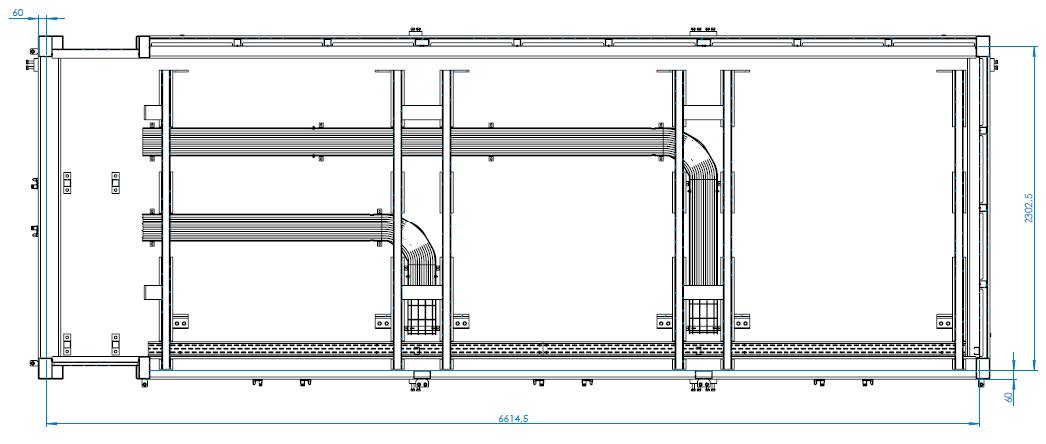
Die Auffangwanne im externen Klimagerät (268 l) ist ausreichend, um den Kühlmitteltank (200 l) zurückzuhalten. Sofern eine Leckage im Wasser-Glykol-Kreislauf erkannt wird (Drucküberwachung), wird die Umwälzpumpe abgeschaltet, wodurch max. das Volumen des Kühlmitteltanks auslaufen kann. Für eine Leckage innerhalb des Containers verfügt der Batteriecontainer im Inneren über eine Auffangwanne mit einem geometrischen Volumen von ca. 820 Litern (L * B * H: 6,6 m * 2,3 m * 0,06 m), abzüglich verdrängter Volumina durch Einbauten. Diese ist ausreichend um das gesamte, vorhandene Kühlmittel (450 l, bestehend aus 200 l Kühlmitteltank und 250 l Kühlmittelkreislauf) aufzunehmen. Für das R513A (gasförmig bei Austritt) ist gem. AwSV (§ 35/§ 38) keine Rückhaltung erforderlich.
| Rückhalteeinrichtung FENECON Industrial XL | |
|---|---|
Gesamtes wassergefährdendes Volumen |
450 l Wasser-Glykol-Gemisch
3.200 l Elektrolytflüssigkeit
|
Erforderliches Rückhaltevolumen — Klimagerät |
200 l Wasser-Glykol-Gemisch |
Vorhandenes Rückhaltevolumen — Klimagerät |
268 l > 200 l |
Erforderliches Rückhaltevolumen — Batteriecontainer |
450 l Wasser-Glykol-Gemisch |
0,45 l/Zelle Elektrolytflüssigkeit |
|
Vorhandenes Rückhaltevolumen — Auffangwanne Batteriespeicher: |
820 l > 450 l |
5. Einstufung des Batteriespeichers nach AwSV
Der Batteriespeicher entspricht einer oberirdischen HBV-Anlage, da wassergefährdende Stoffe verwendet werden.
Aufsummiert enthält der Speicher folgende wassergefährdende Stoffe:
-
204 Batteriezellen x 12 Packs x 3 Racks, je Pack 585 kg = 21,6 t mit WGK 3
-
450 l Kühlmittel mit WGK 1
-
12 kg R513A mit WGK 1
-
7,6 kg Aerosol-System mit WGK 2
-
In Summe: 21,53 t
Der Hauptanteil des Containers besteht aus WGK-3-Batteriezellen, daraus ergibt sich für den gesamten Container die maßgebliche WGK 3. Mit 21,53 t WGK 3 ergibt sich die Gefährdungsstufe D. Gem. Anlage 5 AwSV hat dies zur Folge, dass die Anlage durch einen AwSV-Sachverständigen vor Inbetriebnahme, nach wesentlichen Änderungen, wiederkehrend alle 5 Jahre, und bei Stilllegung, geprüft werden muss. Die WGK-Einstufung und Anlageneinteilung sind vom jeweiligen Betreiber durchzuführen und zu dokumentieren, die hier vorgenommenen Einstufungen können dabei als Hilfestellung dienen, auf Nachfrage können vorausgefüllte Dokumentationsformblätter zur Verfügung gestellt werden. Weitere Betreiberpflichten, z. B. gem. §§ 43-46 AwSV, müssen vom jeweiligen Betreiber berücksichtigt werden!
Zu berücksichtigen:
Innerhalb von Schutzgebieten gem. AwSV (z. B. Wasserschutzgebiete, Heilquellenschutzgebiete, etc.) ist das Errichten einer Anlage der Gefährdungsstufe D gem. § 49 AwSV nicht erlaubt. Eine Ausnahme kann durch die jeweilige zuständige Behörde gem. § 49 (4) AwSV erteilt werden.